

Vast and little known, Kazakhstan’s snow-covered Altai and Tien Shan mountains lie hidden in plain sight. Between nomads, Soviet railways and life that flows between old and new, half the adventure is getting to those mountains. The other half is following locals into their budding backcountry zones.
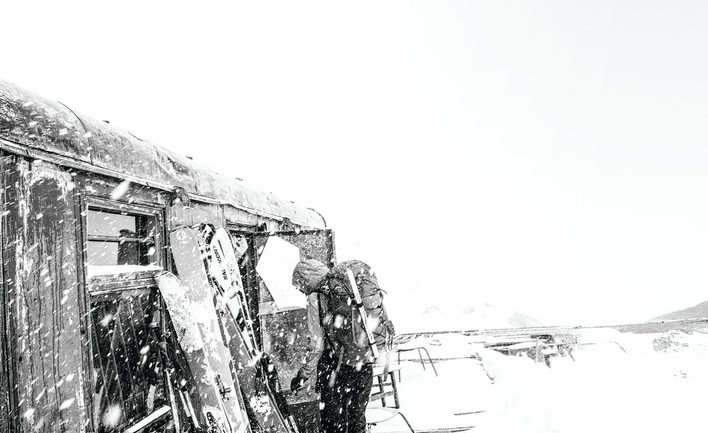
A HEAVY WAVE of fog has blown in, bristling with electricity. Thunder reverberates against invisible rock walls and rolls through valley floors, and the snow keeps falling. Are the rubber soles of my boots enough to save me if lightning strikes? I wonder.
Barely minutes ago, I could make out an abandoned, corrugated-metal trailer to my left, brown rocks to my right and a little stack of hiking signs just past our skintrack. Now, I watch as my friend, Swiss skier Leoni Zopp, who has just joined for the second half of our trip, skins out ahead of me, fading into the whiteout. I wait for the gap between us to grow large enough to follow. As we regroup, I squint my eyes into the storm and strain to make out the blurred edges of a dark structure. We’re nearly there.
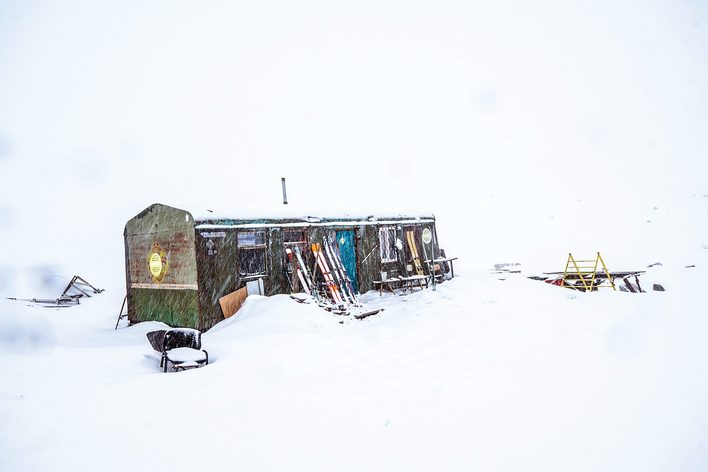
Only up close do the army-green sheet metal, barred windows and bright-blue door of Tuyuksu Hut come into focus, beckoning respite from the storm—a vestige of the Soviet glaciological station that sits nearby but out of sight. Originally designed as lodging for workers, the hut was repurposed and moved onto the moraine for skiers in 2015.
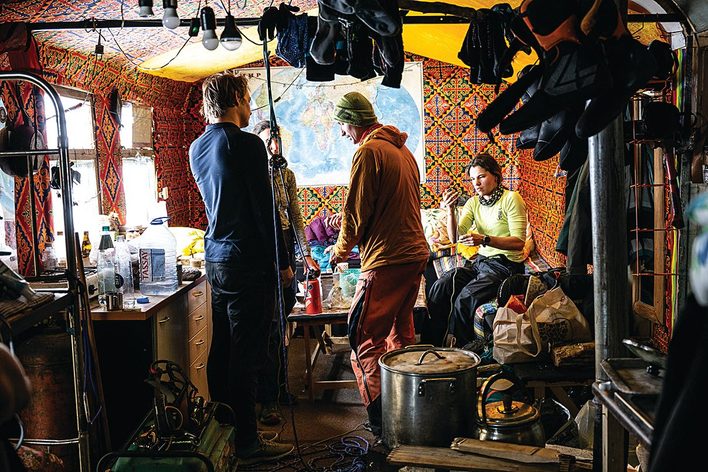
One by one, Leoni, my partner Martin Roeck, friends Kieran Ringel and Lincoln Adam, our guide Maxim Popov, and I file inside. Bright Kazakh patterns—iterating squares of symmetrical designs—carpet the walls and ceiling. The single, long, rectangular room is half living room, half bunk room, split by a woodstove and a single-counter kitchen. A diesel generator sits dormant by the door, and the smell of fuel hangs in the cold air.
Thanks to a snowmobile drop from Victor, who owns the local Qazaq Travel Guide company, our duffel bags and food are piled inside. We stake claims on quilted mattresses and trade shells for puffies before blowtorching the woodstove to life.
Waiting for the clouds to clear, I feel a similar sense of anticipation to when I stepped off the plane into Almaty International Airport nine days ago in the dark of early morning. On the fringe of Kazakhstan’s largest city and cultural capital, we shuffled out to the curb, ski bags in tow. Not a lick of Kazakh or Russian between us, we waved our phones at the string of taxi drivers, Google Translate and lines of foreign Cyrillic letters shining bright. One look at our unwieldly pile of ski bags, and their heads would shake. No luck. This was not a ski destination.
When I told people about this trip, the answer was, “Kyrgyzstan, I’ve heard of that,” as they envisioned horse-accessed backcountry yurts. Almost, I told them, but not quite. Kazakhstan does share its southeastern border and the craggy peaks of the Tien Shan with Kyrgyzstan. And yet, it occupies far less space in the social media feed and imagination of the traveling skier.
I’d only stumbled onto the country the winter before while tracing the snowy reaches of Central Asia’s mountain ranges on Google Earth. If there was snow on the map, I figured, there must be skiing. A quick Google search yielded a list of guided ski touring trips, but only one—Powder Nomads, run by two certified Kazakh ski guides—stood out for its local roots and credibility.
The mountains feel empty, but they’re far from untouched.
It was only when I’d settled into our 15-hour Qatar Airways flight from Seattle to Doha that I pulled up Kazakhstan’s Wikipedia page. Apparently, we were on route to the ninth largest nation by land area in the world. I zoomed in on the map to see Kazakhstan’s borders stretching from the Caspian Sea near Ukraine in the east to a stone’s throw from Mongolia in the west. To the north lies an almost 5,000-mile border with Russia. We would be traversing the eastern side of the country, traveling between Kazakhstan’s two largest mountain ranges, the Altai and the Tien Shan. The scale of the ground I had us covering snapped into place.
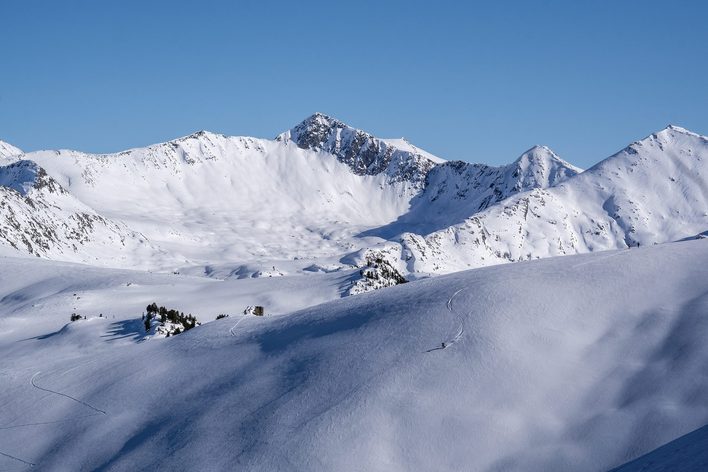
As I look back out the window of Tuyuksu Hut, the Tien Shan Mountains stare back. Glaciers hang off rocky relief, steep faces are coated in snow, and peaks meet sky in every direction. I feel high up and far out, only to wrap around the back of the hut to see straight down valley to the city of Almaty below. The mountains feel empty, but they’re far from untouched.
WHEN WE LANDED in Almaty that March morning over a week ago, we were far from done traveling. Our guide for the first half of the trip, Darya Ponomaryova, co-founder of Powder Nomads, was waiting for us another two-hour flight away. Our first ski destination—a cabin in the Kalmachikha Mountains, a subrange of the Altai—required an additional 10-hour drive deep into Kazakhstan’s northeastern-most corner.
But it’s all worth it when I click into my skis and follow Darya, Martin, Kieran and Lincoln from our remote cabin, past Rakhmanov Lake, through the forest and into the alpine above. My skins glide over a soft wind crust as our group crests the sloping shoulder of an unnamed peak. Here in the Altai, summits abound, people are scarce, and skiers are rare.
Where the Tien Shan are steep and compact, the Altai are massive, broad and rolling. The earth appears thrust up beneath our feet into a flat, high-alpine expanse textured by pyramidal ridgelines and their plunging, wide-open slopes. To my back, the twin horns of the almost 15,000-foot Belukha Mountain on the Russian border rise in the not-so-far distance, defying scale.
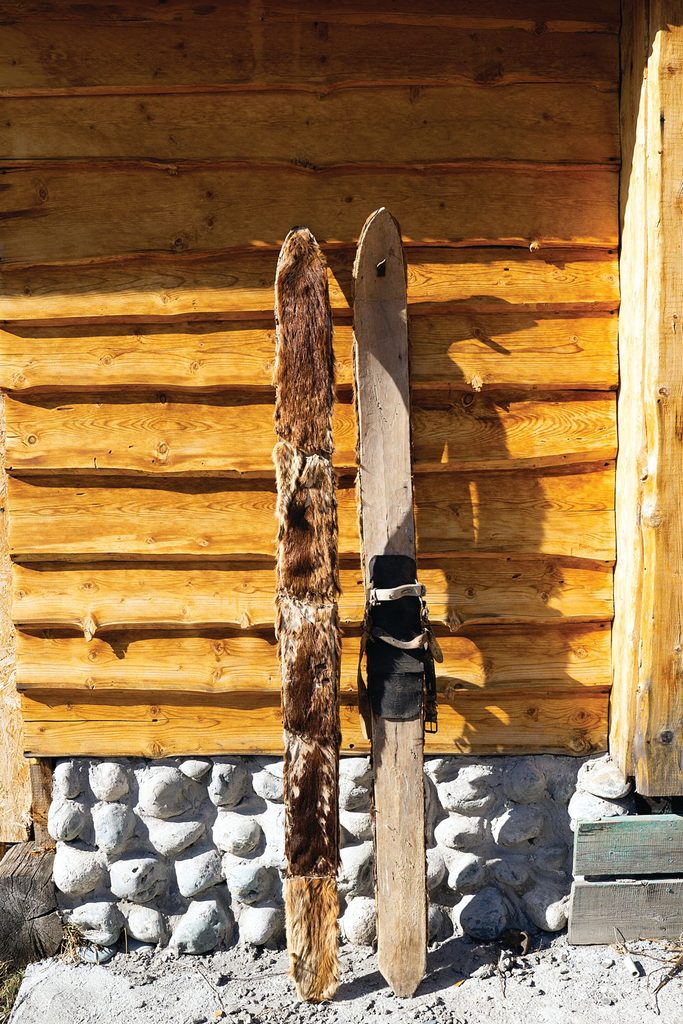
The Altai reaches across from Kazakhstan, into Russia, Mongolia and China. For thousands of years, its inhabitants have used wide, pointed, wooden planks with horsehide bases and leather-string bindings to move through this isolated, rugged snowscape. Modern ski touring has barely gained a foothold in the Altai, and standing just above treeline, I’d guess few skis of any kind have brushed the slopes around us.
Despite the mass of terrain in sight, our objective today is the string of forested, northeast-facing drainages that drop left toward Lake Rakhmanov. Soft and safe, Darya explains. It is not exciting skiing to have traveled so far for. But Kazakhstan’s eastern border is just about as far from an ocean as you can get in the world, and the snowpack is incredibly continental. Average snow depth here, according to Darya, is 5 to 8 feet. A couple punches into the snow with the handle of my pole tell me it’s far shallower. I reach my hand into one of the holes and feel nothing but uniform, sugary grains.
There is no avalanche safety infrastructure in the Kalmachikha or elsewhere in the Kazakh Altai. Instead, we rely on Darya’s local knowledge of weather and the data in the snow beneath our skis. “Sugar powder,” she calls the facets with a laugh. Collapsing of the surface layer on our skin up, plus the crown ringing the drainage to our right confirm our cautious decisions.
These conditions are all too familiar to Darya who has been skiing in the Altai and studying to become a guide over the last six years. Not long before that, she was a snowboarder. But in 2017, her friends convinced her to try skiing and eventually touring. She never looked back.
Kazakhstan lacks a formal governing guide body, so Darya started taking courses with the Kyrgyz Mountain Guides Association (KMGA), forging a path few Kazakhs had taken. In 2020, she co-founded Powder Nomads with fellow Kazakh KMGA guide Alexander Zadneprovskiy, and as of June 2025, she completed her ski guide certification. Though she does some mechanized work, her main focus is human-powered backcountry skiing, and she’s become a point of contact for guides and athletes visiting the country.
When Darya drops in, small clouds float up at the apex of each slow, balanced turn. “Perfect guide turns,” says Lincoln in admiration.
She fades out of sight for a few moments before her voice floods our radios. Our turn. One by one, we point our tips downhill, letting gravity and ski wax do their work. We weave around trees and shrubs and buried rocks and chase each other’s tracks over mini pillows. It comes with a different thrill, not from a technical descent but from knowing we’re laying tracks halfway around the world somewhere most people don’t even know there’s skiing. Five days, eight hours of driving to the northeast city of Oskemen and a 24-hour train ride to Almaty later, the picketed peaks of the Tien Shan loom before me, far closer to civilization than the Altai but no less imposing. Almaty might bustle below us now, but much of the 1,000 miles we traveled to get here was populated with herds of freely roaming horses and small, rural villages of semi-nomadic people.
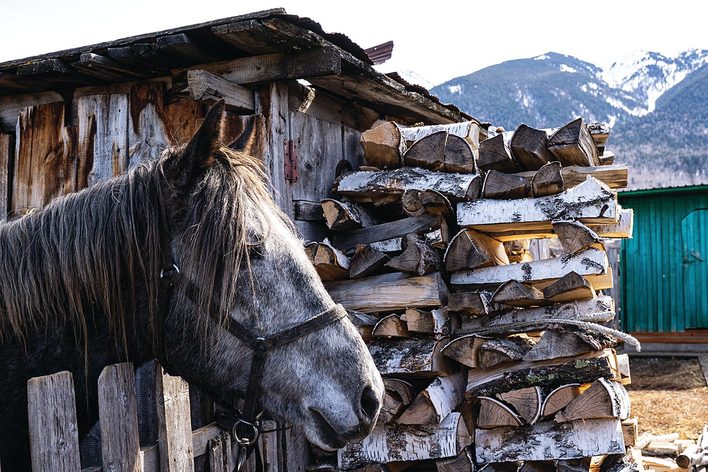
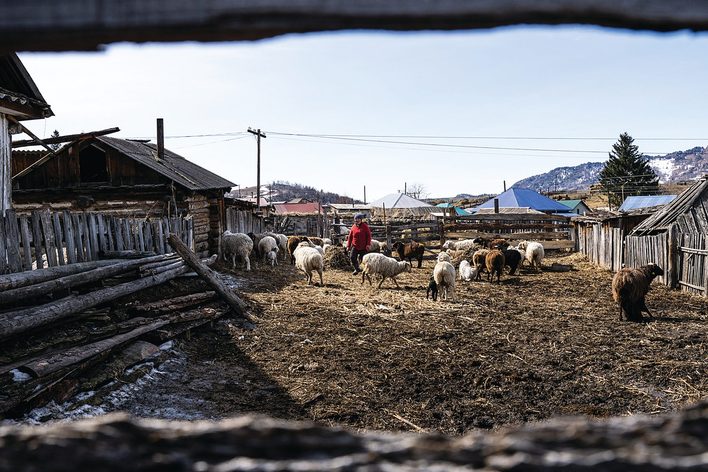
While mountains rim Kazakhstan’s northeast and southeastern borders, the Great Steppe lies in between. This expansive rolling grassland, an ecosystem which stretches in a band from Ukraine to Mongolia, lends itself to a pastoral lifestyle—people and livestock migrating cyclically with seasonal grazing patterns. It’s an ancient way of life, inextricably linked to horses who serve not just as transportation but as meat and dairy, which has survived through khanates (nomadic states) and empires for thousands of years.
Today, many people live in village homes for the winter and move up into the mountains, operating out of yurts, for the summer. “Local life looks like it was during the last few centuries,” our driver Dmitriy “Dima” Rybin told me when I asked what’s distinct about East Kazakhstan. “The type of life—people, what they are doing—it’s the same. This is a really unique thing.”
In 1922, the Soviet Union rose to power. Kazakhstan, already under Russian rule, was subject to the state’s forced collectivization policies. Herds were seized, migration was restricted, and nomadic households were forced to join state farms, practicing modernized agriculture which was not conducive to the steppe. Millions of livestock perished, leading to a three-year famine which killed over a quarter of the Kazakh population.
And yet, culturally, Darya and Dima tell us, far more local traditions lived on in rural communities compared to cities. Religion was suppressed by the Soviet Union, but a blend of pagan, Muslim and Christian beliefs persisted quietly in the mountains and steppe. When the Soviet Union dissolved in 1991 and Kazakhstan gained independence, nomadic traditions resiliently re-emerged, though at a far smaller scale.
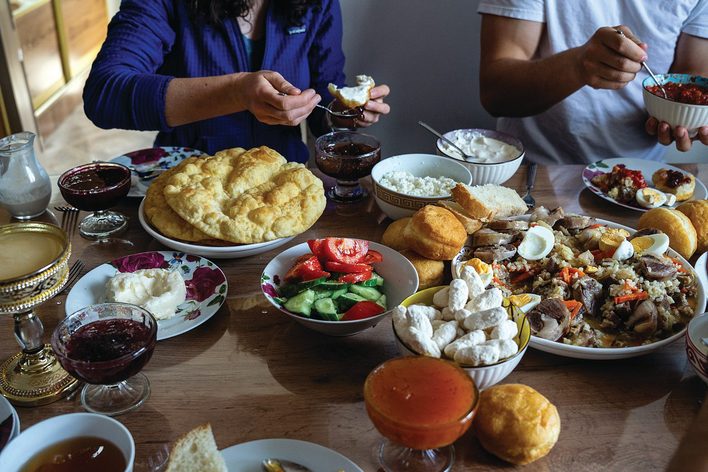
On our drive east from the Kalmachikha to the nearest city, Oskemen, we stopped for lunch with a friend of Darya’s in the village of Uryl. The corner of town consisted of a couple dirt streets, a collection of homes, paddocks and barns, a school and a small military facility. We were greeted with a spread of homemade jams and breads, horse sausage and rice, and something like dried cheese curds. Our host’s husband couldn’t join us because he was busy working leather into a saddle by hand.
We closed the meal with a shared a bowl of fermented horse milk, then walked outside to watch a lone cowboy usher a herd of 50 horses down the highway.
The Soviet-era train we took from Oskemen to Almaty traced a 900-mile artery of the former empire. At 30 miles per hour, our progress across the steppe was faster than it would have once been on horseback, but not by much. Still, the ride makes hailing a pair of EV taxis to ferry us along our next leg, from Almaty into the Tien Shan, feel jarringly modern.
TUYUKSU HUT, with its leaking gas canister, is distinctly not modern. But it’s rugged enough to hold up against the squall that greets us this morning. Our guide for the Tien Shan portion of the trip was supposed to be Darya’s partner, Alexander, but when he bailed due to a broken arm, she connected us with Maxim, who goes by Max.
Max’s quiet confidence calmed us through the thunder and snowstorm on our skin here. Now, as our full packs sit eagerly by the door, he assures us that these storms come and go quickly.
Max, like Darya, came to backcountry skiing after growing up a snowboarder. For him, too, becoming a guide was a path charted not followed. He studied with the KMGA and has recently started his own company, Silk Road Guiding. As of publication, Max is one of two Kazakhs on the verge of becoming a fully certified International Federation of Mountain Guides Associations (IFMGA) guide, with just one ice climbing exam to go.
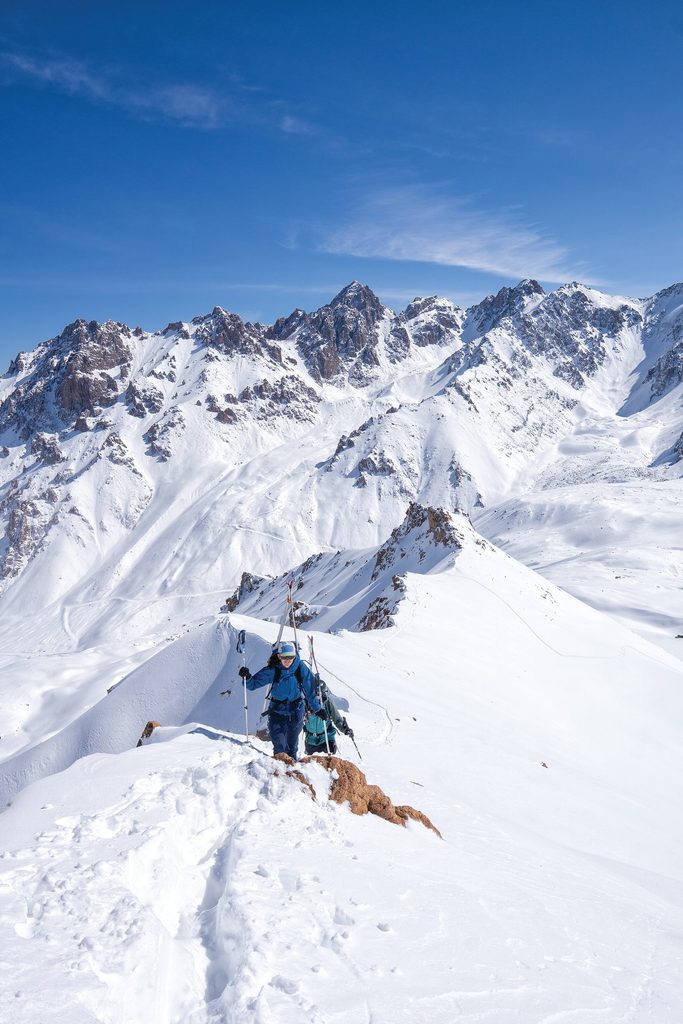
When the wind finally calms and the clouds blow out, we tour up onto a ridgeline to the right of the hut. The snowpack here is faceted, too, so we zig-zag up one of the few shallow, open slopes. Max points across the high-alpine valley below to a tall, steep face with an icy patch in the start zone. It’s a line he hopes to ski.
When the conditions are right, Max is one of the few locals who venture into the Tien Shan to backcountry ski. His preferred method is to depart long before dawn and climb high up for steep descents down ripe, spring corn. Often, he’s solo.
I can hardly imagine skiing the line in his sights, let alone by myself, but it’s a reminder that being a backcountry skier here is a lonely endeavor. And though this budding culture we’ve stepped into exists, it’s shouldered by a dedicated few.
We’re a touch early for soft, stable conditions, but we happily spoon Max’s tracks down toward the hut through sugary powder, enjoying glimpses of the tightly packed buildings of the Tuyuksu Glaciological Station sitting quietly below. We squeeze in two laps before the clouds blow back in.
It’s a reminder that being a backcountry skier here is a lonely endeavor.
IN 1957, the Soviet Union opened Tuyuksu Glaciological Station (T-1), which sits just a 10-minute skin from Tuyuksu Hut in the basin of the Malaya Almatinka River. Its purpose was to measure Tuyksu Glacier’s mass balance (how much it accumulated versus lost). In parallel to research, the glacier’s proximity to Almaty made it a training resource for skiers at Soviet sports schools.
That is how the hut’s owner, 49-year-old Evgeniy Degtyarev, originally an alpine racer for the Soviet Union, was first introduced to the amphitheater of peaks around the glacier. Back then, he explains to me, skiing was not a hobby; it was his job. Though he enjoyed the sport, their training was brutal, and the weight of national propaganda lay on his and his teammates shoulders.
When the Soviet Union dissolved, Evgeniy began exploring the peaks above Tuyuksu. “The ’90s and 2000s in post-Soviet countries were the Wild West,” he recalled to me at a café in Almaty through his friend who could translate. In Russian and broken English, he regaled me with renegade tales of cars on glaciers, bootpacks to 15,000 feet and high-speed slalom turns back to the car. No lifts, no walk mode, no skins, no avalanche gear. All before a day’s work.
Foreign ski magazines and the rare ski tourist offered Evgeniy and his friends a taste of the West’s growing freeride scene. Little by little, backcountry gear made its way into Kazakhstan.
By 2015, Evgeniy was tired of the haul it took to get from the city, up the access road and high into the mountains for a single ski run.
He had an idea. The glaciological station, though still operational, had fallen into disrepair after the collapse of the USSR, and many of its outbuildings were abandoned. Evgeniy and his friends decided to repair one of the station’s deserted train cars and move it to the foot of Tuyuksu Glacier. “Those were truly the best times; we felt like pioneers,” remembers Evgeniy to me later in a WhatsApp message.
Even a decade later, I, too, feel like a pioneer: staying in this train-car-turned hut, sleeping on dented, metal bunkbeds and thick quilts for mattresses, and skiing in sight of no other skiers or tracks.
The colorful rug-like sheets on the walls serve as insulation, but their cacophony of red, orange and blue patterns dulls the reality of the shell that encases them. Structures like this were used by the Soviet Union as mobile housing for often-forcibly migrated laborers. In Kazakhstan in particular, the country’s mineral wealth—critical to the Red Army during World War II—drew Soviet industry and thousands of those workers to power it.
But Kazakhstan has sought to turn the page on that history. Since gaining independence, there has been a concerted effort to incorporate the pluralities of the post-Soviet country, some organic and others created—ethnic and religious, cultural and linguistic—into a comprehensive national identity, not unlike a weaving of colorful threads into a single carpet.
In 2017, Evgeniy opened Alatau Yurt Backcountry Camp in the mountains northeast of Almaty. The camp offers more low-angle terrain and midwinter touring, plus includes a sauna and the option for an included chef. It sounds far more luxurious than our current abode. But I’d rather be here, listening to the wind whip off Tuyuksu Glacier, contemplating history as I wait for the striking peaks outside to once again reveal themselves.
THE MOUNTAINS OUTSIDE Tuyuksu Hut are endless, as are those of the Altai, but just a few small resorts and established backcountry zones exist across Kazakhstan. That’s something Evgeniy, Darya, Max and a small handful of others are working to change.
In a country where the economy doesn’t depend on mountain tourism, skiing has grown quietly. Kazakhstan is one of the highest producers of iron and silver in the world and, thanks to oil and gas reserves, accounts for 60% of Central Asia’s GDP. Developing and publicizing skiing is not something the government seems pressed to invest in.
I think of the videos of influencers trekking and skiing through Kyrgyzstan that populate my Instagram feed. “[Kyrgyzstan] is definitely way more known worldwide in terms of outdoor sports and in terms of tourism in general,” Max says. I haven’t audited the influencers, but my guess is that publicity is a product of investment.
I’d also assume that drive for outdoor tourism is part of the reason Kyrgyzstan has a governing guide body which is a member of the IFMGA. Regulation equates to trusted standards. Though Kazakhstan lacks such an organization, Evgeniy tells me he’s trying to develop one. For now, Kazakhs like Darya and Max, who are interested in becoming certified guides, the only option is Kyrgyzstan.
Even if it’s not something bought into at a national level, Evgeniy, Darya and Max all have seen increased numbers of foreign ski tourists and local clients.
Max sees geopolitics playing a huge role. “I would say Kazakhstan is growing as the ski destination after the beginning of war between Russia and Ukraine,” he reflects. “Siberia was pretty popular destination to visit, and people need alternatives, and [Kazakhstan’s] right here, geographically.” In mid-December, he counted 72 ski bags at the Oskemen airport.
Locally, small incremental steps are being made, too. “Five years ago, [ski touring] was not so popular, but now, more and more people, they just get bored to ride on the resorts,” says Darya. “They want to go off-piste, and they want to reach slopes farther from the resorts.”
Increased use goes hand in hand with increased information. Almaty’s nearby Shymbulak Mountain Resort, the country’s largest ski area, has started hosting speaker-led events on ski and avalanche safety that the public can attend for free. And a simple avalanche bulletin is now published weekly for the Ile Alatau (the Tien Shan near Almaty). To Darya, who helps educate the local community by teaching avalanche safety courses, both are small steps in the right direction.
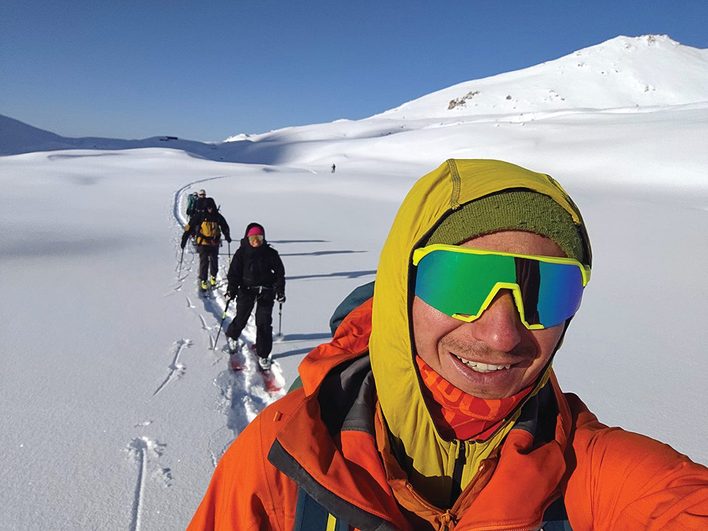
group up Tuyuksu Glacier. Maxim Popov
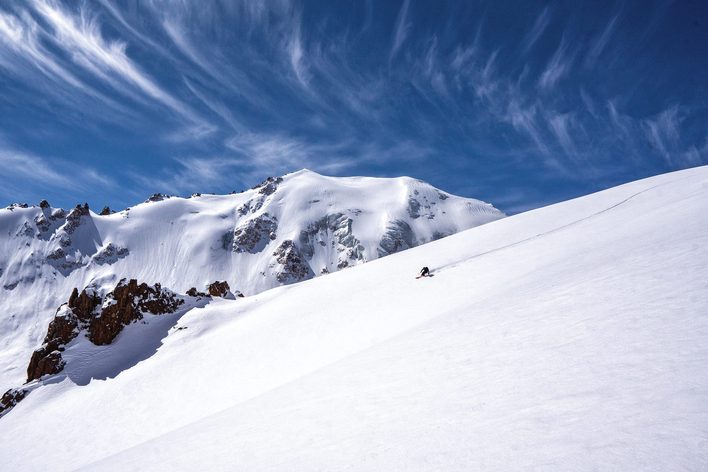
WE LEAVE TUYUKSU in better conditions than we found it—with still air and blue skies—and follow Max to our exit line off the back of the hut. I watch as Leoni carves high on the left wall of the shallow, half-pipe-shaped drainage and wait for my turn to drop. In this glacial-carved amphitheater, we’ve skied only what’s safe, leaving the rest for others or perhaps no one at all.
For our last two nights, we stay two ridgelines over at Yurta Shymbulak, a large yurt at the top of Shymbulak Mountain Resort. Cresting the ridge it sits on, we spot a pair of women, kitted out in pink and blue Dynafit, touring along the boundary line, their tracks trailing into the gully below.
When we reach the yurt platform, we quickly shed our boots and sprawl barefoot on its deck-like edge, marveling at how these peaks have slipped under the radar and recounting the ground we’ve covered. Skiing has collapsed distance here, not just the 900 miles between mountain ranges, but across time and culture and daily life. When the clouds roll in, we retreat to the yurt and pull out a deck of cards.
This article was originally published in Issue 167, The Hidden Issue. Grab a copy to see it in print, or subscribe to read our stories when they’re first published.


Related posts: