

Glacial-carved valleys, classic Patagonian ridgelines and huge, meandering rivers made Chile’s Aysén region a target for extractive industries. For decades, the area resisted. What has emerged is a different kind of frontier and a gnawing question: Can we protect wild places by actually skiing them?
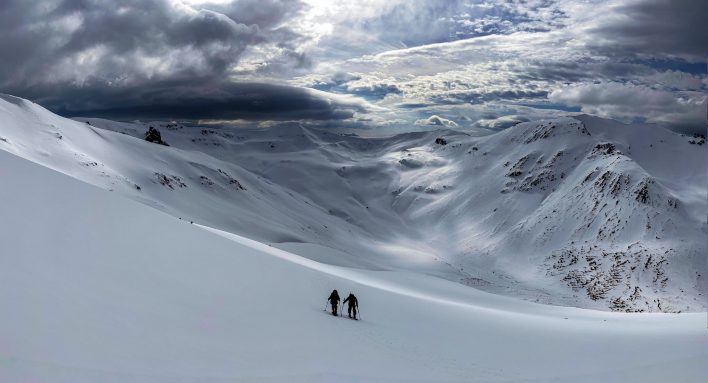
Frozen dirt and shale cascade down into the gully below with each step. A line of boot tracks and pole plants meanders along the sidehill toward a patchwork of frozen snow and persevering green moss. Shoots of yellowed grass sprout up like odd heads of hair. If there were snow, we might be in avalanche terrain. I lay off white knuckling my poles as the hill flattens. A hundred or so feet of quilted snow clings to the otherwise wind-worn shoulder before rolling down into a thick forest of bushy lenga trees. Mud sticks to the soles of our boots. Wind whips over the exposed valleys around us. With some hop turns and careful planning, one could probably link four or five turns on actual snow.
“Let’s just ski from here, no? That moss looks soft enough,“ says Julian Lopez, our guide today. His penchant for sarcasm belies the fact that he’s very much serious.
An enthusiastic nod dissolves any hesitancy. We click into pins and pilot from the backseat, edges rattling off ice before sinking into the soft embrace of lush moss. Our turns resemble the inflatable tube people in front of car dealerships more than any self-respecting skier. Hoots of laughter and ironic shouts of stoke fight against the battering wind. We’re left laughing at the bottom.
Our grass-skiing escapade marks our third day of bushwhacking in the untrammeled environs outside of Cerro Castillo in the Chilean Patagonia. Morale remains at an all-time high, despite potentially the worst snow year in the past three decades. You wouldn’t guess it from our overland excursions, but the vast and almost entirely untapped ski potential of the Aysén region, and Villa Cerro Castillo specifically, inspired the trip I’m currently on with Alpenglow Expeditions.
Just two years ago, Gaspar Navarrete and Diego Saez pitched Alpenglow the trip to this sparsely inhabited corner of the world. While we’ve been bushwhacking to snow this year, Saez and Chilean locals have been able to tick off a smorgasbord of delectable lines straight from the road in previous seasons.
Saez moved to Villa Cerro Castillo three years ago, after guiding in the area since 2015. Originally from Punta Arenas, further south in Chile, he was drawn north by the increasingly rare ability to explore a winter snowscape and an abundance of high-quality rock climbing. By his best estimate, he’s still only one of 12 skiers local to the area, most of whom have moved to Cerro Castillo from larger cities for the potential for roadside exploration that’s rare in this part of the world.
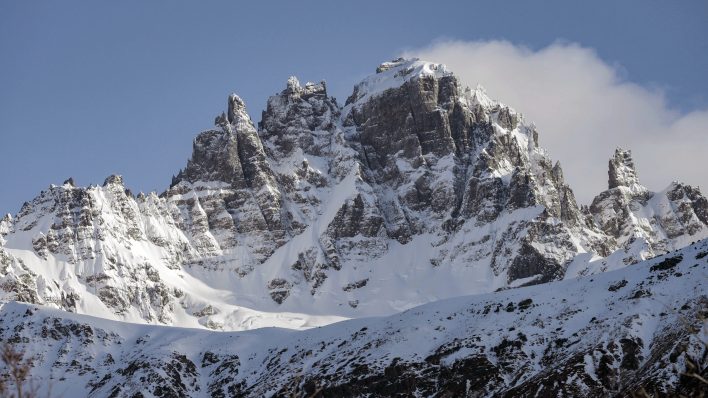
Even over the phone, his excitement for this zone is tangible. The Cerro Castillo massif rises to 8,700 feet, its castle-like spires of granite and ice giving the range its name. The peaks are adorned with glaciers and split by couloirs that funnel corn in the spring.
“We have a lot of steep lines and first descents waiting to be skied, and a little bit further south, we have the Northern Ice Fields, which is like a whole new world,“ Saez explains. “It’s full of challenge and of remote mountain expeditions to do there. It’s hard to see at some times, but if you travel a little bit along the region, the potential is massive.“
In theory, plenty of Patagonia offers similarly unexplored potential on snow. What sets this sleepy village apart is access.
Built in the 1980s, the Carretera Austral, also known as Chile’s Ruta 7, cuts a lone figure through impenetrable rainforests to the west and stepped, rolling hills in the rain shadow to the east. The 770-mile highway was the first modern throughway connecting Chile’s rugged, southern frontier over land.
When Navarrete pitched this trip, he imagined an off-the-beaten-path location with roadside access to steep, rowdy lines in powder or spring corn. It was the dream location that he’d been searching for across South America since he became one of the first Ecuadorian internationally certified mountain guides.
Our Toyota Hilux trundles to a stop on a gravel shoulder. The pull-off is marked only by a sign for the protected huemul deer and a shin-high wooden stake with a kilometer marker, the red paint sun-faded to pink. Usually, that stake would be buried by snow.
Lopez, an internationally certified mountain guide who hails from Bariloche, Argentina, laughs and tells us this is typical Patagonia. Apparently, skiing from the road is a treat, not an expectation. Cerro Castillo usually serves dessert; that’s part of what sets it apart from other zones in the area. This year, however, the snowline taunts us from 1,000 feet above the road. We attach skis to packs and shoulder our gear for a rather technical scramble through lenga trees and over frozen scree and patches of icy snow.
Eventually, the basin opens its maw, and we transition to skins, picking our way through jumbled rocks and spurts of tundra. Alpine bowls rise up in every direction. A condor circles above. Contrasted against the endless peaks, its 10-foot wingspan looks remarkably unremarkable.
I skin alongside Alpenglow Expeditions owner, internationally certified mountain guide and renowned mountaineer Adrian Ballinger as we wend our way upwards, following the refrozen track of an unknown predator. His lanky frame glides across the frozen snowscape, taking one step for every three of mine.
Ballinger moved from England to the U.S. at age 6 and almost immediately picked up skiing at the rolling, local hill of Massachusetts’ Mount Wachusset. He took up rock climbing a few years later, mentored by a family friend.
At 17, Ballinger was brought to Ecuador’s volcanoes by Chris Warner, another renowned alpinist and founder of guide company Earth Treks. The trip cemented Ballinger’s path in mountaineering, eventually leading to his 2004 founding of Alpenglow Expeditions.
“One of the reasons I started Alpenglow instead of working for another company was that I never wanted to just drag people to summits,“ says Ballinger when we’re both back in the U.S., patiently waiting for snow to fall on the northern side of the globe. “That’s never been mountain guiding for me. For me, it’s been educating people so they could be confident in the mountains themselves.“
Guiding for his own company, Ballinger slowly built a name for himself and Alpenglow. Sponsorships followed, and he’s now summited Everest over a dozen times, once without oxygen, and skied off of three 24,000-foot peaks.
Despite the pages-long resume and decades of experience, Ballinger is still just as stoked as we are to thwack through shrubbery and shoulder skis for a long slog of an approach to predictably meh skiing.
In fact, that suffering and the lack of given success is why he still does it.
“Being in the mountains doing hard things is one of the easiest places that I’ve found to experience awe, to experience that true feeling of being overwhelmed by what we’re experiencing,“ says Ballinger. “It happens so frequently out there. And in so much of our lives today, I think we don’t experience that. We’re so sheltered from all the extremes—pain and pleasure. The humility or humbleness that comes from that really has the potential to change us.“
Ballinger effortlessly swings skis back onto his pack and transitions to crampons for the final booter to the top. On the ridgeline, waves of peaks amass into the far stretches of Cerro Castillo National Park. Even the lack of quality snow conditions doesn’t hinder the awe-inspiring vista.
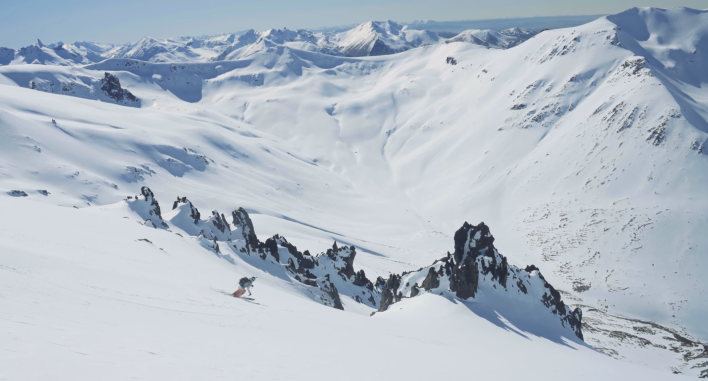
Relentless wind hurls frozen shards of snow at any unprotected skin as we transition. Our guides claim it’s a calm Patagonian day. One by one, our group of almost a dozen skiers drops down a 20-degree slope, making the most of a few inches of windblown Dippin’ Dots on edgeable rain crust.
The wind agrees to a temporary ceasefire on an icy, midslope shoulder, and Ballinger and I pause to chat, our conversation wandering from summer climbing objectives to wilderness ethics and access. We’re in no particular rush to ski.
“Anytime we travel in the backcountry, go into the wilderness, visit remote places, we are having an effect on those places from a pure conservation standpoint,“ Ballinger says. “If humans never stepped foot in places, they would be more pristine. But with that said, I don’t think all of our backcountry or all of our environment should be untouchable.“
It’s a tension that feels particularly relevant here in Cerro Castillo, where protecting wilderness and increasing access seem perpetually at odds. The Carretera Austral opened these mountains to the outside world. My writing might do the same. It’s a thought process Ballinger shares, but he’s not worried about it, per se.
“I think we actually protect things better as a society when we actually interact with them and develop true relationships with them and care for them,“ Ballinger says.
The words hang in the wind for a moment before a radio crackle lets us know it’s time to drop. We follow the command, scraping our way down to the valley floor.
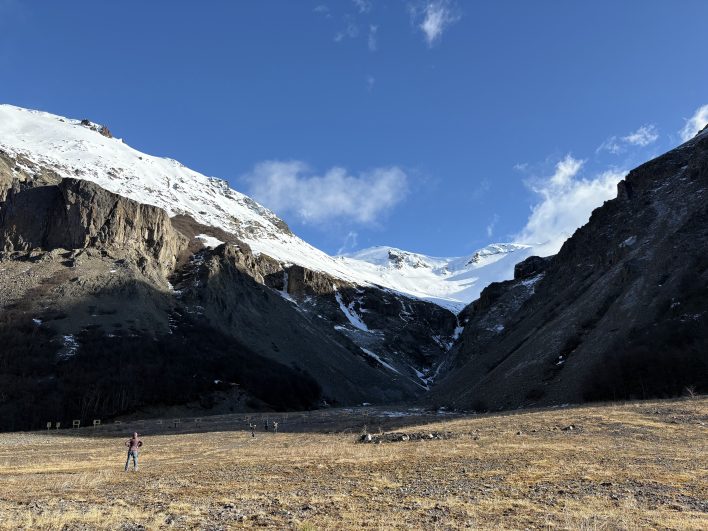
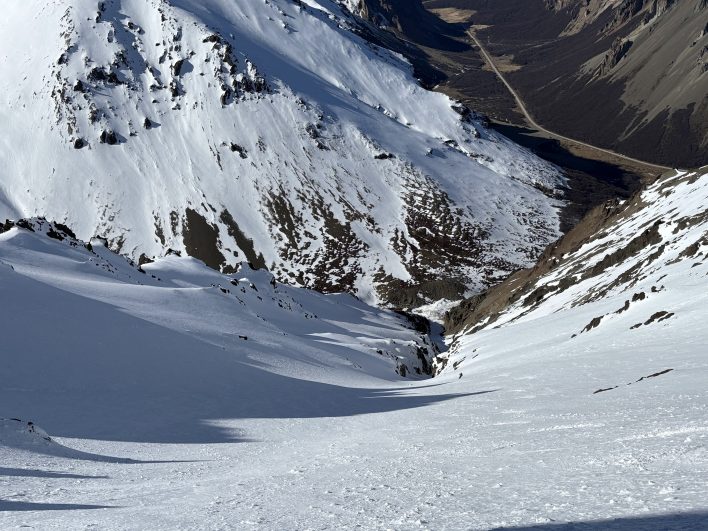
The following day, we return to the same valley. As we break into the alpine, I glance over my shoulder at a plunging, northeast-facing couloir. It’s a prize line with a sketchy entrance leading into a pristine face and a steep, high-walled exit chute. Massive blocks of refrozen snow and chunks of rock litter the apron all the way down to the valley bottom.
The overnight freeze was minimal, even at elevation, and we race the clock toward a cloudy summit. From the top of our objective, Custodio, Navarrete points through holes in the cloud cover to various landmarks, spires and couloirs. In the distance, a bolt of white rips thousands of feet down an otherwise impervious face. “The locals are thinking about skiing it,“ he says. “It’s probably a first descent.“
The line would be an instant classic anywhere else despite the bushwhacking debauchery required to access it. We take a second to plot how one would cross the wandering mass of the Ibañez River to get there. The waterway turns a corner and meanders out of sight. In the distance, Lago General Carrera spreads over the border into Argentina, eventually feeding the opaque turquoise, glacier-nutrient-enriched Baker River.
If it weren’t for a group of gauchos and local Aysén communities, the expansive wilderness below our feet might have looked very different. From 2004 to 2014, hydro-electric company HidroAysén proposed five dams on the Baker and Pascua rivers that would have flooded nearly 15,000 acres. The project was the biggest attempt to industrialize the Aysén, an area the size of Pennsylvania where only around 100,000 people reside. Local communities rallied behind a campaign called Patagonia Sin Represas—Patagonia Without Dams. After 10 years of protest, then-President Michelle Bachelet withdrew state support, shelving the project.
From my vantage point atop the peak, I think of what it would look like if a dam flooded the valleys like these below—transmission lines and hydroelectric equipment whirring, population expanding with a necessary workforce. It’s hard to imagine given the utter lack of infrastructure I’ve seen so far, but the possibility was very real. Instead, glacial-fed water still runs unimpeded from under our skis, down rugged mountains and, eventually, into the Pacific.
The next day, our plans for exploration are scuppered by verglas-covered rocks, overhead hazard and sun-brittled fixed lines. Given the foreboding name of our objective—Diablito, the little devil—our chances of a successful mission probably weren’t great from the start. We retreat to treeline and pick our way through mud and between low-hanging lenga branches draped in old man’s beard. A fairytale light fills the interstitial space between snaking trees and the faintest signs of a beaten-in footpath.
Lenga forests like the one we hike through stretch to the farthest points north and south in Patagonia. But some of these groves almost disappeared decades ago. In the 1990s, the U.S.-based Trillium Corporation proposed a 990,000-acre forestry project to harvest lenga forests in northern Patagonia. Despite Trillium acquiring the necessary permits and funding, indigenous Mapuche people joined arms with environmental activists and united behind their concern over the sustainability of the proposed industrial logging. The project was tied up in courts, mired with doubt and eventually drained of financial resources until Trillium backed out. It remains one of the most successful conservation campaigns in Patagonia. Thanks to that work, Seuss-looking ecosystems like the one we’re trekking through still exist in droves.
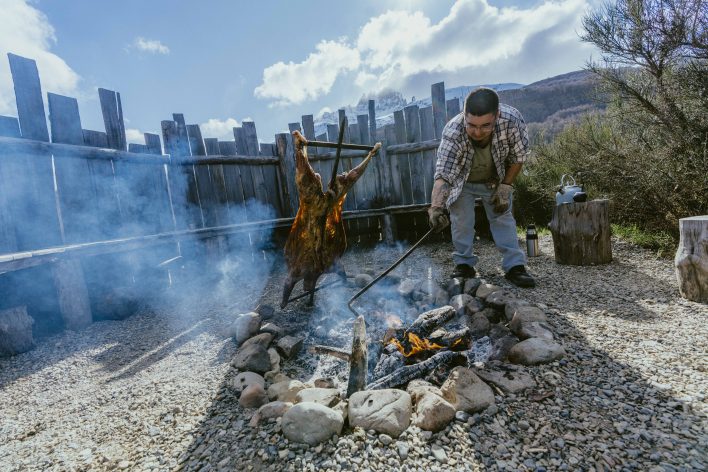
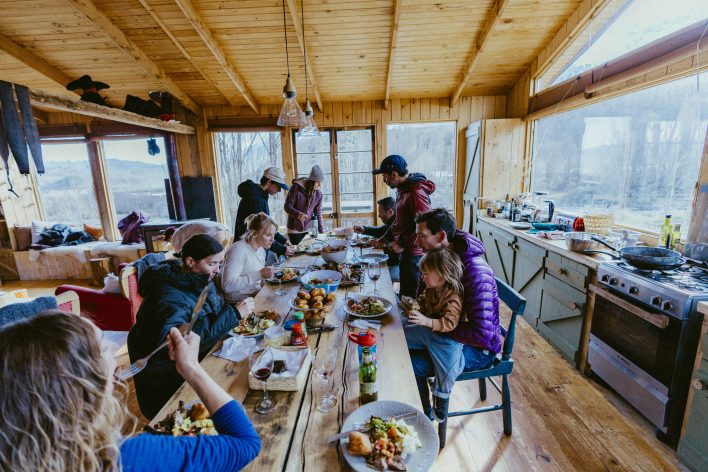
A dreary, frozen drizzle keeps us inside the following day. After a morning detour to a somewhat nearby climbing gym, we return to Villa Cerro Castillo and a traditional asado. A lamb is crucified over a smoldering fire, and the clouds have parted to let in brave stabs of sunlight. Two locals tend to the embers, chatting and sipping mate.
We break bread and sip wine and talk with the asado makers in ragged Spanish. They hail from Coyhaique, and one has started an ecotourism business in the summer where tourists help maintain cabin upkeep as part of their stay. After hours of watching the coals, the asado is ready. One of the two locals flips open a knife and carves lamb straight off the stake, piling teetering strips of meat onto small plates. We feast and share stories about almosts and what-ifs and previous adventures. As the night goes on, I stuff sopapillas, delectable fried balls of bread, into a plastic bag for future skintrack snacking.
On the last day of the trip, we finally wake to a deep frost and truly bluebird skies. Sunrise is marked by a pink hue cast across the many east-facing snow panels that speckle the horizon line.
For the fifth time this week, we boot up on the roadside and teeter over frost-covered rocks, across streams and through lenga dressed in more bearded lichen. Within minutes of the first light filtering through the canopy, petite, green parrots called cachañas explode into melody. Surely, it’s a good omen for corn skiing to come.
I take a second to drink in the surroundings and munch on two-day-old sopapilla. To the south, glaciers form waves on the horizon. Somewhere in the overexposed glare between ice and sky, the Northern Icefields that Saez mentioned and the San Lorenzo massif in Patagonia National Park offer up hundreds of unexplored lines. The scope is hard to imagine, even with a viewpoint of it all. And all of it is protected, in large part, thanks to late climber and The North Face founder Doug Tompkins and his wife Kris.
In the ’90s, the couple started assembling what would become the largest private land donation in history. After founding The North Face, as well as fast-fashion company Esprit, Doug sold his shares and moved to Patagonia. Driven by a resolve to protect the places he loved, he and Kris bought approximately a million acres of land in Chilean Patagonia, plus more in Argentina, and offered to donate it back to the government in the form of national parks. They leveraged their donation with the Chilean government to upgrade protection on existing government land totalling over 9 million acres.
It was a bold move, and one that faced fierce resistance. Right-wing politicians and think tanks accused the Tompkins of locking up natural resources. Patagonia National Park became the flashpoint for this tension. But Doug and Kris pressed on. Over three decades, they rewilded degraded ranchland, reintroduced species and built infrastructure for ecotourism. In 2017, the Chilean government signed the Parklands Protocol with Tompkins Conservation, accepting the keyhole parcel of donated land and matching it with public holdings to create Patagonia National Park, the 17th park in the Chilean Patagonia alone.
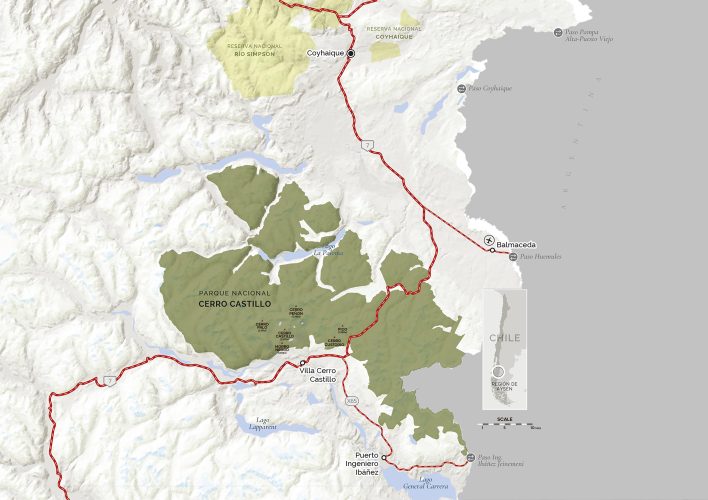
Cerro Castillo National Park, where we’ve spent the past seven days skiing, was originally designated a national reserve in 1970. In 2017, as part of the Parklands Protocol between the Chilean government and Tompkins Conservation, it was upgraded to national park status. The shift means stricter protections against extractive industries and increased funding for infrastructure and management.
“A lot of people in conservation say it’s a green lung for the world, and I do think that Chileans are already really proud of having this place that is exceptionally, relatively intact. Especially as places become more destroyed by our consumption of them,“ says Carolyn McCarthy, Director of Global Communications at Tompkins Conservation, in an interview.
Also a backcountry skier, she sees the vast potential of Patagonia. Tompkins Conservation has spawned two independent rewilding organizations, and McCarthy tells me there are plans for an 18th park in the works, one she says, “where I’m sure skis have never touched down on most of those mountains.“
The parks are still a work in progress, and the goal for Patagonia to help the world breathe is likely only feasible with tourism dollars from recreation.
“There was confusion about permits, about where we could actually ski,“ says Saez about the region when he first arrived. “The park infrastructure feels half-finished.“ Specifically, it’s unprepared for growing winter recreation. But he believes it’s possible to establish improved management.
“When this gets massive, when there are more people here, we just need to be proactive about how we develop new routes,“ Saez says.
Eventually, I pull my gaze away from the expansive wilderness and rip skins. A set of ski tracks snakes down the cold south face, the first sign of other skiers all week. Saez may see a future of winter tourism, but it’s clear there aren’t many people here yet.
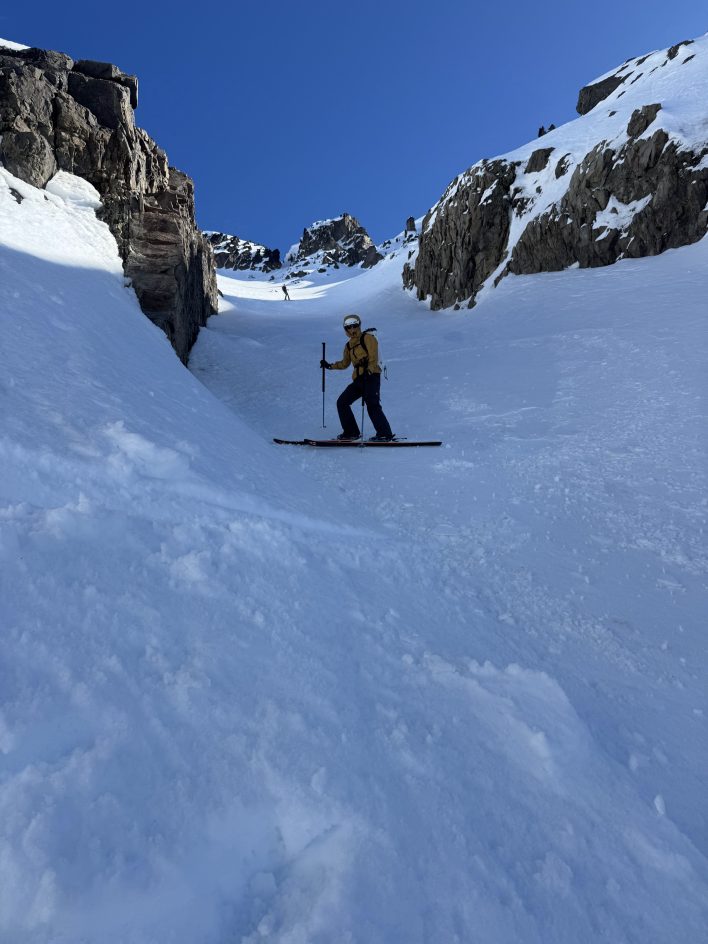
We turn east, away from the tracks and toward the couloir I’ve been dreaming of since we first arrived. The entrance, only a touch wider than my ski length, is an unappetizing mix of terrifyingly slick ice and sticky mank split down the middle. I sling an ice axe over a shoulder strap and wedge it between my back and pack for easy access.
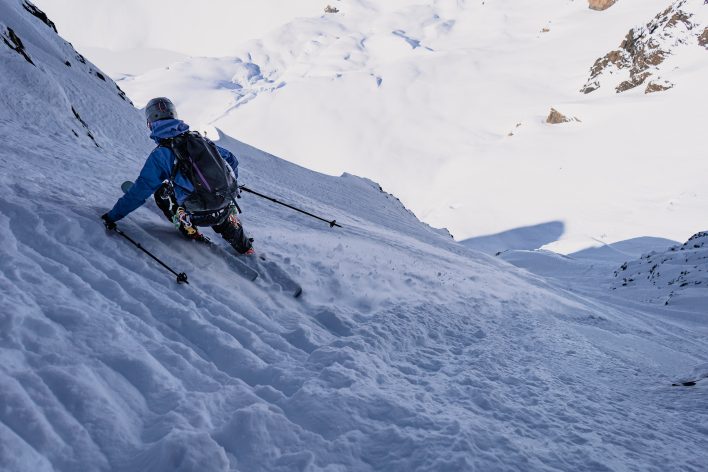
We pause on a precarious ledge halfway down and switch to crampons, given the slide-for-life potential, to downclimb the final hundred feet of the entrance chute. Sharps stowed and skis on, the proper headwall opens up below, illuminated by the last weak rays of the sun. A mellow wind swirls and the top few inches of snow slide away like marbles under our edges. We rip 1,000 feet of GS turns in the last light of day. At the bottom, I’m met with full-face grins and hoots of laughter.
“You don’t go to South America for good snow,“ Ballinger reflects on our call. “When we go to these places, it’s for the whole experience. The adventure, the unknowns, the fact that you might nail it. And when you do nail it, it’s so spectacularly special.“
Despite a week of decidedly bad skiing, Alpenglow will be back. Saez continues to espouse the brilliance of this little-known tract of the world, too. He’s currently working on a guidebook slated for publication next winter. When I question both on the idea of oversharing one of the last largely protected regions of this planet, neither are too concerned.
“I think sharing wilderness is more likely good than bad,“ says Ballinger. “But the how matters.“
For Ballinger, and by extension Alpenglow, that how is dining in local restaurants and developing connections with folks like Saez. And, as McCarthy says, “Have a light touch.“ If done right, sharing wilderness can cultivate advocates for a protected planet, as well as an appreciation for life with less—fewer amenities and less infrastructure—giving space to more wild places.
For now, Cerro Castillo is characterized by what doesn’t exist: dams and infrastructure, logging projects and ski lifts. It remains a quiet place. A conserved place. That won’t change. Anyways, even the quietest places are full of sound. The rivers and wind and mountains, the cacophony of cachañas, all of which existed long before anyone set foot, or skis, in Patagonia.
This article was originally published in Issue 166, The Quiet Issue. To read in print, grab a copy, or subscribe to see our stories when they’re first published.
Related posts: