


Skiing, surfing, mountain biking, free diving, mushrooms, skeletons, lasers and the Grateful Dead. On paper, it reads more like a chaotic charades list than the blueprint for a film. But in Chris Benchetler’s wonderfully bizarre imagination, this is exactly what he fuses together in his newest cinematic experience, Mountains of the Moon.

The film is anything but your typical action sports movie. Everything scene is shot at night, with athletes wrapped in custom, glowing skeleton suits. The pre-production phase alone—concept development, assembling the team and securing funding—took a full year. Two years of filming followed, with editing occurring in tandem as each discipline was shot. Naturally, part of the skiing segment unfolded on Benchetler’s home mountain of Mammoth.
I happened to be living in Mammoth Lakes and working at the resort while some of the skiing was filmed, though I had no idea at the time. What I did know was that a 100-foot-long kicker shaped like a wooly mammoth had been carved into the snow, taking up half a run. As I learned at the global premiere in Santa Monica, they did use that jump, but not in a way I, or anyone else (unless your name is Chris Benchetler), might expect. In the dead of night, lit by custom skeleton suits, skiers and boarders launched into darkness, sailing over the Grateful Dead’s 82-year-old drummer, Mickey Hart, as he tapped out a beat atop the snow sculpture.
What couldn’t be seen during my time at Mammoth was that the film’s snow athletes, including Michelle Parker, Elena Hight, Sam Kuch, Danny Davis and Dennis Ranaltar, ventured beyond the resort, too. Accompanied by an entire production crew including a lighting and laser team, they headed into the backcountry. Facing storm conditions, deep powder and complete darkness, the film and lighting crews hauled hundreds of pounds of equipment into the mountains to illuminate an otherwise uninhabited stretch of wilderness, and the athletes charged pillow lines and carved through feet of fresh.
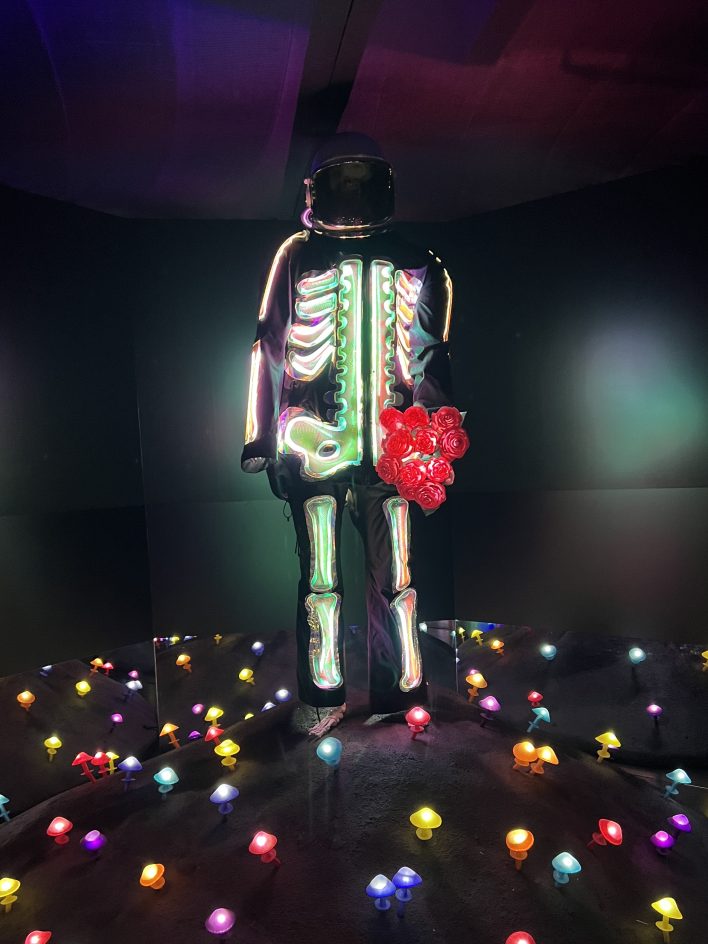
This level of effort was carried through every other discipline of sport: climbing granite faces, mountain biking through a drenched Oregon forest, surfing in a wave pool, and free diving with jellyfish and whales off the coast of Tofino, all set against a midnight backdrop. Each sequence required meticulously planned shots, some taking hours to set up, and all came with their own complications, especially when the weather refused to cooperate.
At the premiere, both athletes and crew seemed to share the same sentiment: No one really knew what they were signing up for—not even Benchetler—but they wouldn’t have missed it for the world. When I sat down with him before the premiere, I asked what made him believe a project this ambitious could have no limits. “I have an issue of dreaming so big that I don’t view limitations,” he answered with a smile. “And I think I’m inherently optimistic—I don’t really see that things are gonna go sideways”.
That optimism fuels the rest of his creative process. “I’m a huge risk taker on myself because I know what I’m capable of pulling off,” he added. “Because I’m seeing it all in my head”.
Watching the film, I felt like I was getting a peek into that headspace, into a corner of Benchetler’s brain that words can’t quite capture and reality can’t quite replicate. It was as if I’d been transported to another planet, watching athletes do what they do best, but in a midnight world shaped by manipulated light and glowing bones. The familiar sports and locations became surreal, elevated into something entirely new.
The athletes felt that energy too. “The more he explained his vision for the film to me, the less I understood,” climber Alannah Yip admitted to me with a laugh. Still, she was immediately on board. It was an ambitious undertaking, and both athletes and crew were encouraged to shape the project with their own creativity. With zero blueprint, everyone had to get a little inventive.

Narration by author and mycologist Paul Stamets, renowned for his work with mushroom mycelium, ties the film together. Close-up shots of intertwining mycelial networks, set alongside athletes navigating the landscapes that shape them and their sport, illustrate how everything, from fungi to humans, is part of a continuous loop. The movement from the forest floor to mountaintops and oceans makes Benchetler’s point clear: Every line we draw—on skis, bikes, ropes, or boards—intersects with something larger. Stamets’ words echo the logic of the mycelium itself, tying every corner of the film into one living system.
The soundtrack by the Grateful Dead, who also scored Chris’s previous film “Fire on the Mountain,” sets the film’s hypnotic pulse. Mickey Hart’s drumming, paired with the Dead’s unmistakable groove, feels raw and alive, like tapping into Earth’s heartbeat beneath us. At times, it seemed less like the music was accompanying the film and more like it was responding to it. Around me, people began to sway almost unconsciously, drawn into a collective pulse that matched the landscapes on screen.
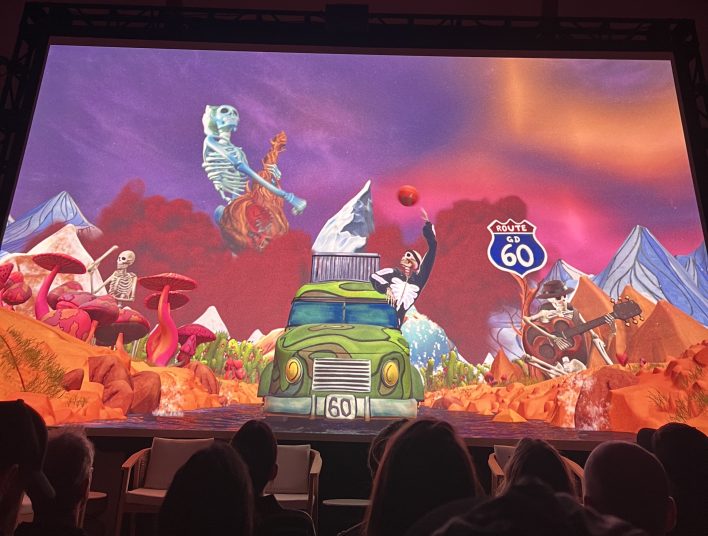
A recreation of Chris’s studio was set up at the warehouse premiere, and I found myself imagining what it would be like to be in his shoes, thinking up impossible ideas and somehow pulling them off.
Watching the premiere, I was struck by the sheer devotion, not just the physical labor, but the endless creative problem-solving, that went into this project over three years of production to bring a 45-minute film to the screen. “I just hope people walk away thinking that this earth and this life is pretty cool,” said Benchetler. “And they can enjoy it however they want to enjoy it.”
The film will tour with Arc’teryx-hosted screenings at select North American locations, as part of the Arc’teryx Winter Film Tour in Europe and at select events throughout Asia. It will also receive a limited theatrical release worldwide. More information on showings can be found here.




Related posts: