

The USDA formally proposed a plan to rescind the Roadless Rule, but there’s still a public comment period to defend it.
On August 18, the U.S. Department of Agriculture (USDA) announced a plan to rescind the 2001 Roadless Rule, which “prohibits road construction, reconstruction, and timber harvest in inventoried roadless areas because they have the greatest likelihood of altering and fragmenting landscapes, resulting in immediate, long-term loss of roadless area values and characteristics,” as stated in the Federal Register. The change would endanger more than 25,000 miles of trails, 10,000 climbing routes, nearly 1,000 miles of whitewater and more than 10,000 miles of mountain biking, according to Outdoor Alliance.
According to the U.S. Forest Service, one-third, or 58.5 million acres, of our National Forest System lands are inventoried roadless areas. This categorization began in 1964 when the Wilderness Act was created. Since then, these lands have been effectively preserved from the logging and development that can happen on non-roadless Forest Service land. They protect some of the last undeveloped backcountry as well as wildlife habitats and clean water.
The first attempt to rescind the Roadless Rule came in 2025 when USDA Secretary Brooke Rollins announced, “President Trump is removing absurd obstacles to common sense management of our natural resources by rescinding the overly restrictive Roadless Rule.” The USDA press release later stated, “This action aligns with President Trump’s Executive Order 14192, Unleashing Prosperity Through Deregulation, to get rid of overcomplicated, burdensome barriers that hamper American business and innovation.” The government’s main critique of the Roadless Rule is that it prevents wildfire management.
However, the Roadless Rule specifically allows for construction in the case of fire prevention or management. “You still have roads and trails. You can still do fuel removal work for wildfires. They’re really not that restrictive, but the benefits are outsized,” says Dani Poirier, the director of Wasatch Backcountry Alliance (WBA).
According to Tom Hallberg, the Idaho conservation associate for the Greater Yellowstone Coalition (GYC), increasing access through road development may actually increase fire risk, not decrease it. “The vast majority of fires are human caused, and 90% of them happen within a half a mile of a road,” says Hallberg.
Idaho, where Hallberg resides, and Colorado have their own roadless rule, which together protect 13.5 million acres. Despite the local protection, Hallberg is still concerned about the national recession of the Roadless Rule. For one, GYC serves the greater Yellowstone area, with 10 million acres of the Yellowstone ecosystem that extends into Montana and Wyoming protected under the current federal Roadless Rule. And while rescinding the Roadless Rule might not affect Idaho now, Hallberg is worried it could set a dangerous precedent. “There’s no proposal right now to take it away, but I could see a future in which that happens,” he says.
In a future without the Roadless Rule, the western U.S. would lose huge amounts of large, connected spaces that are crucial for wildlife. “The impacts on individual species are different, but roads in general have been shown to basically cause animals to avoid certain habitats,” says Hallberg. “They don’t like crossing roads, even rural dirt forest roads.” Not only do these roadless areas protect wildlife, but they also protect the water. “More than 60 million people in the West get their drinking water from roadless areas,” he notes.
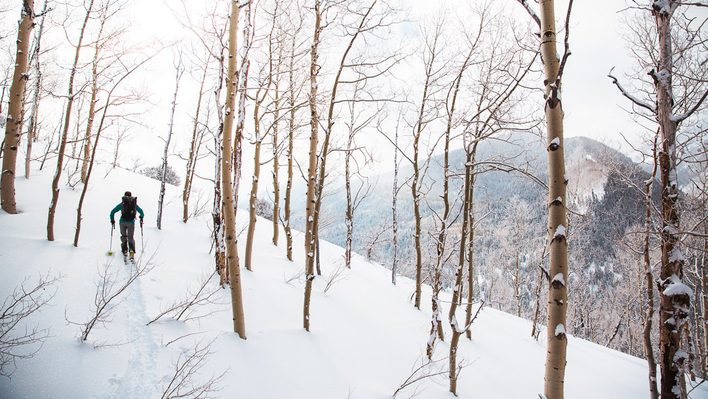
As we talk on the phone Hallberg looks out his window at a roadless area in the Tetons. The west slope of the Tetons, almost entirely inventoried as roadless, is a place Hallberg counts as special. “A lot of the places I go backcountry skiing currently don’t have roads,” he says. “They don’t have a lot of access other than human power in the winter, and that’s kind of important for what I want to do as a recreator.”
Poirier is an avid backcountry skier in the central Wasatch, where WBA makes it their mission to protect the balance between undeveloped and developed terrain while protecting access to backcountry trailheads. According to a WBA press release, over 300,000 acres of the Wasatch are inventoried roadless areas. “If we start cutting roads through those, you’re going to lose the backcountry characteristic,” Poirier says. She later adds, “We know there are tons of users out there, but it’s really hard to quantify just how important it is to have access to these wild spaces. You know, there’s so many people who choose to move to Utah over other areas because of our access here, and that’s a really hard dollar value to pinpoint.”
Vermont is my home, and as I hiked through a new-to-me part of the state’s wilderness this past weekend, I wondered if I would feel the same peace if the Green Mountains were no longer green and abundantly filled with a thriving forest. In the early 1900s, only 20% of Vermont’s landscape was forested. Since then, the numbers have reversed, with forests now covering 80%, according to the Vermont Natural Resources Council.
“Rarely do you have the public access like we do here in America. It would really change the character, especially of the Mountain West, if we lost our public lands,” Poirier emphasizes.
“People’s feelings about their community and how they view their own community is intrinsically tied to those public lands that are around them, and without the public lands and without the protections that they currently have, I think that people’s understanding of the places that they live and their connection to the wildlife and the lands and the people around them would change,” Hallberg reiterates.
A public comment period opened on August 18, 2026, and close for comments on September 21, 2026, at midnight. Learn more or make a comment here.

Related posts: