

ZipFit’s new Espresso liner is a worthy upgrade for almost all touring boots.
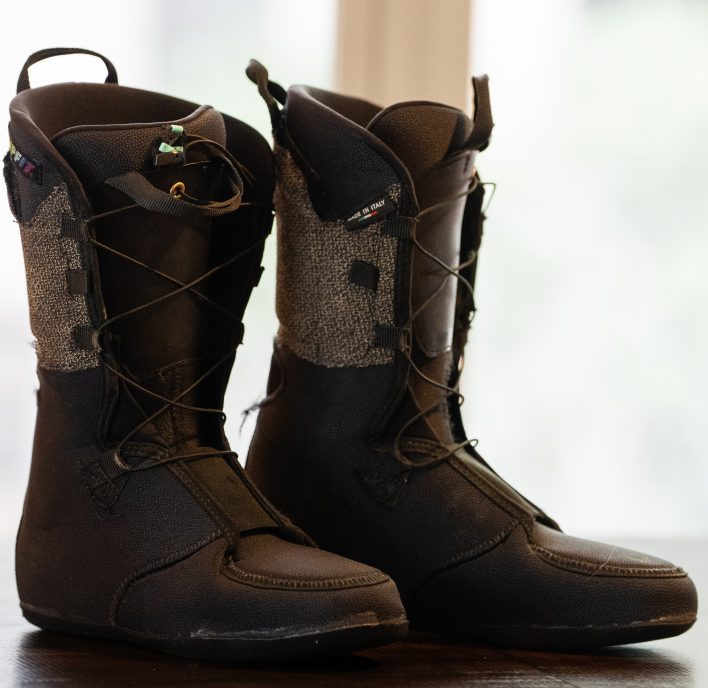
$535 | zipfit.com | Sizes: 21.5-31.5 | Weight/Pair: ~600g (24.5)
Two months ago, ZipFit’s newest touring liner, the Espresso, arrived in a package on my front step. Before even opening the box, I noticed the weight—or lack thereof. For the last two months, I’ve skied the Espresso in my Tecnica Zero G Pro Tours, as well as various lighter-weight touring boots during our Gear Test Week. And the more I ski them, the more I think these may be the best upgrade I’ve made for my touring setup in the past few years.
Construction
The Espresso is a departure for the Italian company. ZipFit liners have traditionally been built from leather, neoprene and cork. The GFT, ZipFit’s first touring liner, drew devoted fans and a persistent criticism: it skied great, but wasn’t exactly made for touring. At around 1,200 grams per pair, the weight penalty just wasn’t worth it for dedicated backcountry setups. Plus, the neoprene toe box froze on overnight missions. The idea of the Espresso was born from that problem, reportedly after Cody Townsend spent time on Mount Saint Elias and his GFT froze in the cold.
The resulting liner, the Espresso, comes as the first real, touring-forward liner in recent years from any company. It still features ZipFit’s signature cork pouches, one on each side of the ankle and one on the tongue, which let you dial in fit and extend longevity. The tongue is still reinforced with plastic over the front, but the toe box is made from thermo-moldable foam, a new direction for ZipFit. In theory, the resulting liner offers the same customizable performance at a lower weight and without the freezing issues on overnight adventures.
There are some smaller touches that make a difference, too. A Kevlar backing wraps around the top of the liner and adds durability for racer-style entry. On the back of the calf, that Kevlar forms a pouch that can hold the included spoiler and tuck away laces for long days.
Fit
Fit has been ZipFit’s selling point, and nothing changed with Espresso. I went the professional route, molding the foam toe box with an actual boot oven. ZipFit says the toe box can also be molded at home using any sort of oven, heated boot bag, hot rice in sock method or other heating device, as long as the liner stays under 140 degrees Fahrenheit. Out of the box, the Espresso’s toe box was quite roomy, and the molding was a necessity for my low-volume feet. Luckily, a couple of minutes in the oven sorted that quickly.
In general, the out-of-the-box fit seems fairly mid-volume. For my exceptionally low-volume feet, this meant I originally felt like I was swimming in the Espresso, but ZipFit sells extra cork tubes ($15 for a 15-gram tube, $40 for two tubes and an applicator) to add volume in the tongue and both ankles. The process is simple enough that I was able to figure it out with a few YouTube tutorials, and it goes a significant way to maximizing performance. While the additional cork adds a few grams, the lack of heel lift feels worth the weight.
Performance
Unsurprisingly, an over-$500 liner did make a notable difference in downhill performance across multiple boots while still allowing for a shell’s full range of motion. In my four-buckle Zero Gs, there was no discernible difference in how the boot walked with the Espresso compared to the original liner. I even switched out the stock liner in a pair of Dalbello Quantum Frees, a two-buckle, walking first boot, and was still able to smoothly use the entire, viable range of motion. Across boots, the heel hold from the custom fit was impressive. On the ascent, that resulted in a complete lack of hotspots or blisters once the liner was fitted properly, an issue I’ve had with almost all stock liners in the past.
On the descent, the Espresso performed admirably as well. It’s no GFT, and it’s not meant to be, but it still drastically increased precision. The plastic tongue increases the contact point between the shin and the front of the boot, adding control and comfort for the descent. This increased contact, paired with the notable structure and dialed fit of the Espresso, seems to add consistency through a boot flex’s range.
The performance difference is more pronounced the lighter the boot it’s paired with, obviously at the cost of extra weight. In boots looking to maximize both downhill and touring performance (think Tecnica Zero G, Dynafit Radical Pro), that difference mostly came down to a more secure fit. In lighter boots with flimsier stock liners, I felt the actual cork and plastic tongue of the boot slightly stiffened the flex, and at the very least added a consistency that’s often lacking on the lighter boots.
I wouldn’t suggest the Espresso for anyone running a hybrid boot setup. It’s still a lighter liner and will be undergunned in an Atomic Hawx, Salomon Shift, Tecnica Cochise or most other resort-focused boots.
Bottom Line
For me, the Espresso has been a real upgrade, both in terms of performance and comfort. Additionally, I suspect ZipFit’s new liner will hold up much longer than any stock option. The option to keep adding cork means that the liner packing out won’t be a problem, especially in touring boots that are getting hard use every year.
For someone looking to blend performance and tourability, the Espresso is the best aftermarket liner I’ve used to date. To be fair, it should be at the price point. But if you want the best of the best, you’ll have to pay for it. And while, as noted above, there are better options for skimo gram-counters or true hard-charging, the Espresso is a best-of-both-worlds, walking up and skiing down pretty damn well.
Related posts: