

What do you call a snowboarder in court? The common answer to the joke is the defendant, but we call them the judge, and our crew of splitboard testers ruled on the carvability, slashability and popability of these boards, boots and bindings.
Each split is tested by roughly seven testers, each of whom takes the product out for at least three lift-access runs and/or a tour. An item that performs well in its intended category is a Gear Guide Select. A product that performs well beyond its intended category earns an Editors’ Choice (EC).
See our Editors’ Choice splitboards here, or find one by weight below. You can also search for a brand or splitboard.
Editors’ Choice
Editors’ Choice
United Shapes Deep Reach Split
Totally Tubular
Weight: 3,511g (156) | Lengths: 156, 159 | Price: $949 | unitedshapes.com
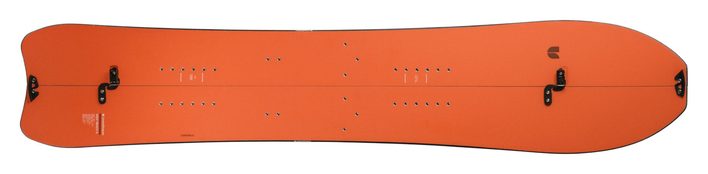
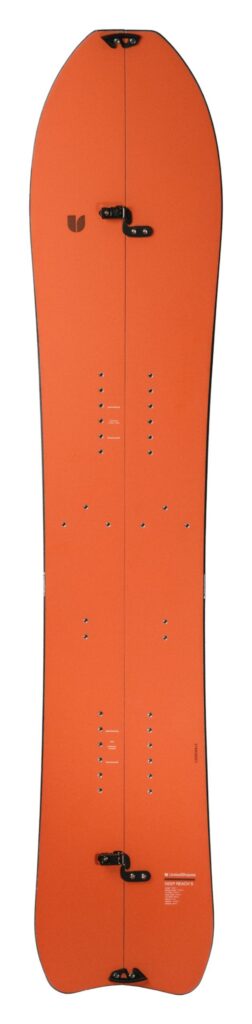
The top-scoring, surf-inspired shape of recent years, United Shapes’ directional Deep Reach is unsurprisingly a dream in soft, smooth snow and surprisingly capable in less ideal conditions.
On a powder-blessed spring mission in the Eastern Sierra, the Deep Reach earned its deep-snow stripes thanks to substantial waist width, setback and taper, as well as a rockered snout that “planed to perfection,” according to a Tahoe rider. Nose rocker flows fluidly into grippy camber underfoot, and a sidecut that favors mid-radius arcs “turned like a well-heeled stallion: obedient, graceful and never bucking its passenger,” reported a tester. He was also impressed by the stable tail’s reliability after hop-turning over exposure on a classic Sierra tube and its ability to throw joyous slashes on solar windlips, all on the same tour. “The camber, tail shape and stiffness bit into steeper walls well, but my favorite moments were definitely flowing down windblown wave forms.” A Colorado tester agreed that edgework was the Deep Reach’s calling, saying, “A monster while turning, holding smoothly and releasing easily.”
Most of our crew found the medium flex—which comes from the poplar, paulownia and beech core laminated with triaxial glass and vertical carbon stringers—complements the build well and added to the Deep Reach’s damp, easy-riding DNA. However, our heaviest tester wanted a less pliable platform. The Deep Reach is no featherweight, either, but it toured well compared to surfy competition. The biggest dings were significant delamination on the tested sample and a two-size release.
“If you want a directional, setback shape that can handle any terrain but is still fun for mellow riding, this is for you.” —Will Sardinsky
Where to buy
United Shapes Deep Reach Split
Editors’ Choice
Weston Backwoods Splitboard
All You Can Eat Buffet
Weight: 3,461g (160) | Lengths: 157, 160, 163W, 167W | Price: $989 | westonbackcountry.com
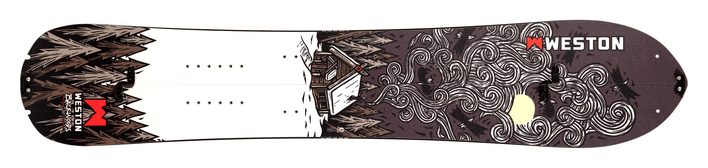
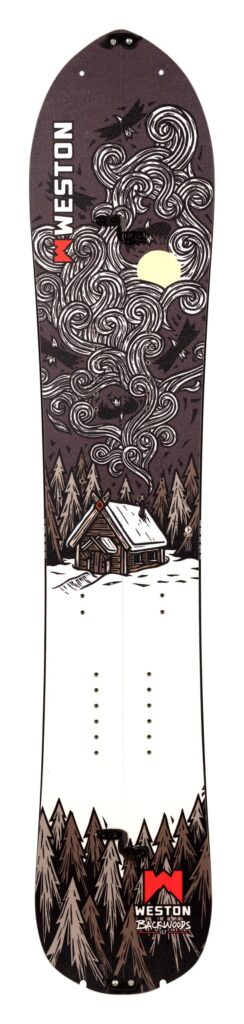
The Weston Backwoods wins its fourth Editors’ Choice award, adding another trophy to the Colorado brand’s sagging mantle. The unchanged split continues to be a quiver killer for riders of most ability levels. But switch specialists and freeriders who want an elephant gun (to borrow a phrase from our wave-chasing brethren) should look elsewhere. This year, we sent the Backwoods to Alaska, where elephants abound and mega freestyle features do, too. And the Weston slayed it all.
A glade-gobbling sidecut and quick edge-to-edge transitions are balanced with a pow-plowing prow of a nose. The poplar and bamboo core buttressed by vertical carbon stringers give a mid-stiff flex, and the camber-dominant profile crushes carves. “Surfy—amazing versatility and stability for every condition you throw it in,” commented a smitten splitter after a weeklong glacier camp, whether that’s “handling tight trees or straight-lining through a big Alaskan apron.” The flex pattern had a Goldilocks level of “juuuuuust right” to it, he said. “Holds strong through tough times but doesn’t lack playfulness.” And while the setback, tapered Backwoods doesn’t excel switch, he was stoked on the carbon-backed tail’s ability to snap ollies and touch down gracefully. “Anything that resembled a transition was mine for the taking—it felt like a pogo stick.”
Gripes were few, and the most common was the limited size run. Weston makes a softer Eclipse in smaller sizes, but a female tester wanted the Backwoods’ backbone in a shorter length.
“Like a pubescent teen at a buffet, it ate up anything and everything you put in front of it.” —Ryan Irvin
Where to buy
Weston Backwoods Splitboard
Editors’ Choice
Venture Storm Splitboard
Rain or Shine
Weight: 3,400g (157) | Lengths: 152, 157, 162, 169 | Price: $999 | venturesnowboards.com
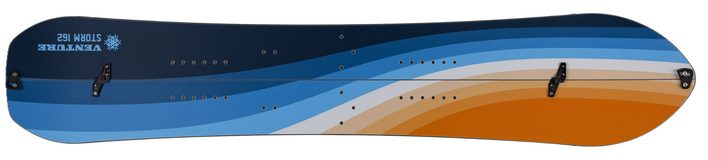
You don’t have to be a meteorologist to forecast that there’s a high chance Venture’s Storm wins an Editors’ Choice award around here. This is the Storm’s fifth EC award, and testers were yet again impressed with the Silverton boutique’s bombproof, best-in-class construction. They also appreciated the versatile shape and flex pattern that “balances the knife-edge between agility and stability, playfulness and power,” according to a Sierra shredder.
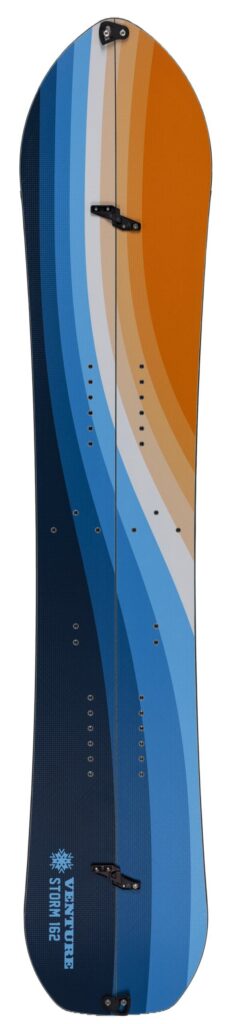
With 3 centimeters of setback, a touch of taper, a buoyancy-boosting arrowhead nose and a stubby tail, the flat-cambered Storm features a mid-range sidecut and a mid-flexing, damp poplar and maple core. “Fun in smooth stuff, capable in tech-gnar,” voiced that Sierra rider. “Nimble agility for tree dodging,” gushed a Vermont glade specialist, who loved the edge-to-edge speed of the workable waist and reactive torsional flex. A harder-charging Colorado rider agreed and also gave the Storm props for the “snappy, poppy tail that was both stable and explosive.” He found the shape “easily transitioned from a surfy feel to responsive edgehold” at the whim of the rider.
As always, Venture scored well for durability thanks to a sintered base, damping P-tex sidewalls, wrapping stainless steel edges and a textured topsheet. It’s not the lightest split on the market, but it’s built to last. While the Storm is the definition of a quiver killer, aggro freeriders may want more backbone, and the shape unsurprisingly doesn’t ride switch nearly as well as the Venture Paragon.
“It carves better than Uncle Donny carves the Thanksgiving turkey, is more lively than Afroman’s career resurgence and rips harder than Jack.” —Will Sardinsky
Where to buy
Venture Storm Splitboard
Editors’ Choice
Stranda Biru Splitboard
Daily Driver
Weight: 3,184g (154) | Lengths: 154, 157 | Price: $995 | strandasnowboards.com
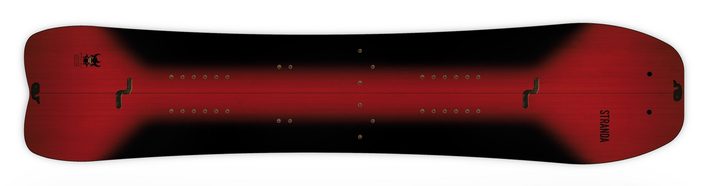
If you’re on the hunt for a volume-shifted shape that chews through chunder, say hello to the Stranda Biru, now a two-time Editors’ Choice winner. “Much like a pitbull, the Biru is squat, powerful and capable of biting through just about anything you feed it,” voiced a Sierra tester. “It’s quite lovable and tons of fun once you get to know it.”
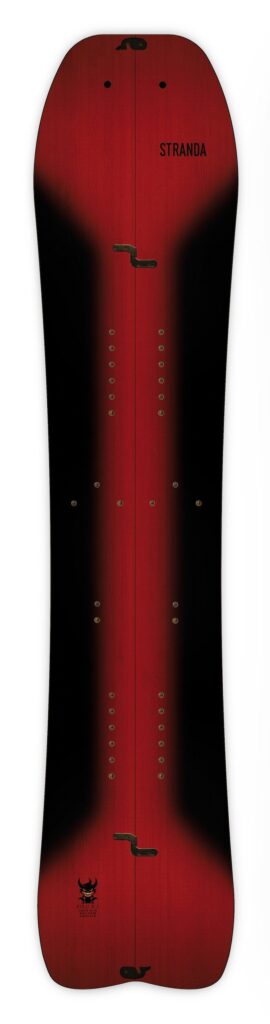
The Biru’s broad belly and shovel nose let our riders float into the whiteroom with ease, but this split won’t be boxed into being a pow board. A huge 6-millimeter camber pocket extends under the inserts underfoot, and, when combined with subtle serrations along the short, progressive sidecut, the Biru grips hardpack with the best of ’em. “I’d take this anywhere,” commented a Colorado rider. A Utah tester with a ragged passport agreed, calling it a consummate travel board. “If you’re flying somewhere, this is a good bet,” he reported.
A paulownia-dominant core laminated with triaxial glass and braced with carbon stringers gives the Biru a stiff flex throughout, while an even stiffer tail provides “confidence-inspiring landings,” according to the Coloradan. More playful and lighter testers felt that the flex pattern was best reserved for experienced splitters over greenhorns, but heavier, harder-charging testers argued there was no reason average joes couldn’t grab the Biru for average tours.
“Solid daily driver for the connoisseur of volume-shifted shapes. It’s hard to think what it can’t do.” —Drew Zieff
Where to buy
Stranda Biru Splitboard
Editors’ Choice
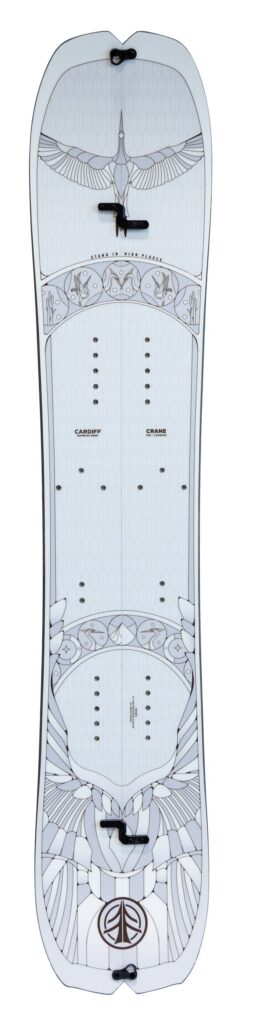
Cardiff Crane Pro Carbon
Uphill Maestro
Weight: 2,903g (158) | Lengths: 146, 150, 154, 156, 158, 162 | Price: $1,350 | cardiffsnow.com
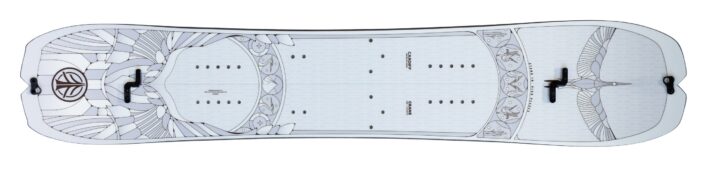
Even if we ignored the featherweight Crane Pro Carbon’s uphill acumen, the Cardiff board would’ve been in the running for an Editors’ Choice award based on its downhill performance alone. It’s a setback freeride machine designed for “big-mountain boarders who don’t want to sacrifice freestyle flow and who drool over lines littered with pillows, poppers and cliff drops,” per one Sierra slasher.
Testers loved that the Crane’s imperceptible taper enabled switch takeoffs and landings and encouraged the pursuit of hangtime. They also appreciated the instantaneous response of the carbon construction that delivered powerful, poppy ollies. But the shape doesn’t compromise when it comes to float, either. “Had my deepest days of the season on this deck, and the mid-wide chassis floated like a pontoon boat,” approved the Sierra rider. On more technical lines, the stiff tail and camber underfoot gave the Crane reliable, confidence-inspiring edgehold for hop turns and sketchy traverses. “The versatility makes the Crane as good as it gets for a carbon quiver killer,” reported a tester. However, another rider warned that the stiffness of the carbon build calls for aggressive handling and felt intermediate riders should steer clear.
Still, the Crane Pro Carbon was virtually unbeatable on the uphill, and one tester jokingly called it a cheat code to help him keep pace with his fastest touring partners. One of the pitfalls of carbon craft is durability, and the slim build’s thin base had testers worried about longevity.
“This is the most capable and reliable board I’ve ridden this week. I wouldn’t hesitate to take this board into consequential terrain.” —Chris Cloyd
Where to buy
Cardiff Crane Pro Carbon
Editors’ Choice
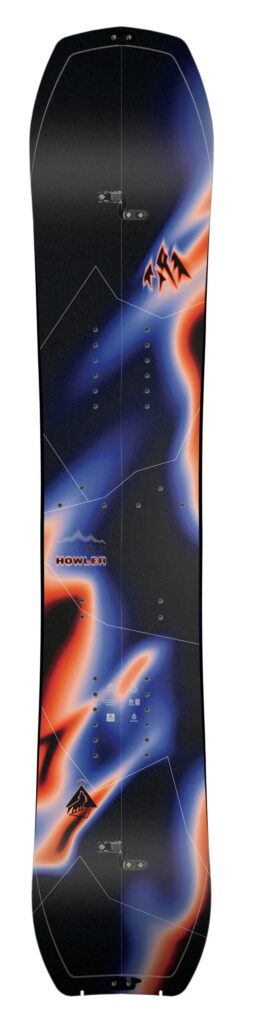
Jones Howler Split
Freerider’s Delight
Weight: 3,000g (158) | Lengths: 158, 160W, 161 | Price: $1,050 | jonessnowboards.com
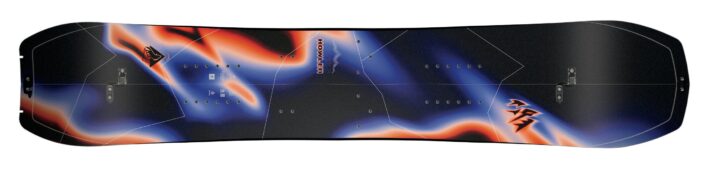
When Jones announced a split version of the Howler, tester expectations were high. After all, the solid is a freeride-meets-freestyle torpedo with a stout, kicked tail co-designed by Victor de Le Rue and Elena Hight. Those high expectations were exceeded during extended testing in the High Sierra.
“After weeks of testing, in every condition imaginable, I never threw anything at this board that it didn’t handle excellently,” reported a skintrack slayer. A mid-stiff flex from a two-to-one poplar-to-paulownia core and vertical carbon and flax stringers, camber underfoot and a generous sidecut turned “like a riot” in mellow terrain, per said tester. Jones’ spooned nose and tail allow rolled, fluid turns. The same tester said the bomber tail showed “shades of the OG Flagship” (a freerider’s highest compliment) and was able to hold fast in tech terrain. “I connected 12 consecutive 47-plus-degree hop turns in pow,” he explained. He also credited the tail for handling cliff drops well, allowing for freestyle expression without limiting freeride performance.
A Koroyd insert—a collection of shock-absorbing, glassed-in hollow straws—in the nose helps the Howler cut weight, but vert-focused gram counters will gravitate toward Jones’ lighter, carbonified Ultra series. Regardless, camber and a serrated inner edge supplied grip on sketchy spring uptracks, and tester-approved Karakoram hardware earned additional points on the descent. However, one critic found the deck leaned more toward ferocious than fun, and he recommended that lighter, less aggressive riders look elsewhere.
“Fall-line-oriented freeriders with a penchant for the stray 360 or Devun Walsh impression should consider the Howler as a potential next daily driver.” —Chris Cloyd
Where to buy
Jones Howler Split
Select Splitboards
Venture Paragon Splitboard
Weight: 3,220g (158) | Lengths: 149, 153, 154, 158, 159, 163, 164, 171 | Price: $999 | venturesnowboards.com

“I’ve never ridden a split that I trust as much in technical terrain that will also inspire me to spin cab 3s or 5s off a cornice,” commented a Sierra all-mountain rider. A flat zone underfoot transitions into a rockered nose and tail, while minimal taper and 2.5 centimeters of setback give splitters buoyancy, playfulness and switch skills. The malleable-yet-reliable poplar and maple core is buttery and poppable for freestyle applications, but it still provides stability and confidence when hop turning in no-fall zones and straight-lining chokes. Venture’s industry-best durability—triaxial fiberglass, sintered base and sidewalls, full-wrap steel edges and textured topsheets—put more feathers in the Paragon’s cap. Those sidewalls in particular allow for damp, chunder-absorbing descents. But the construction is also the sole complaint: This board isn’t light. Venture also makes the Carbon Paragon ($1,299), a lighter weight offering with a similar construction.
TL;DR: A highly durable albeit heavier quiver-killing split that’s buttery, playful, reliable and primed for all-mountain airtime addicts.
Where to buy

Venture Paragon Splitboard
Venture Euphoria Splitboard
Weight: 3,200g (156) | Lengths: 150, 156, 164 | Price: $999 | venturesnowboards.com
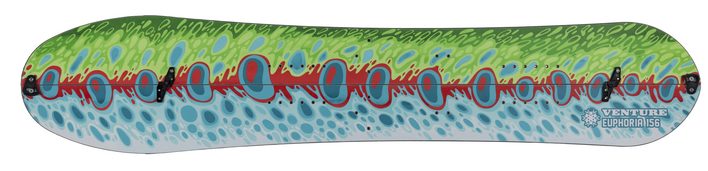
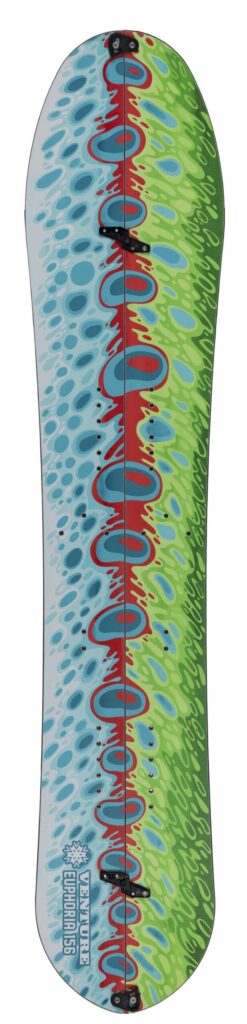
For the average backcountry boarder, this beak-nosed boat is a specialized addition to the arsenal best reserved for deeper days. The ant-eater-sized schnoz is unparalleled in the float department, and it tapers 25 millimeters back to a relatively tight pintail. Factor in 40 millimeters of setback, and the Euphoria mitigates back-leg fatigue whether you’re surfing in Myoko or the Monashees. An impressed Coloradan dubbed it a cruiser perfect for “stoner dads and powderhounds.” Multiple riders agreed the Euphoria was not winning any races on the uphill, given the weight of Venture’s durable construction and the balance point of the nose. The Colorado rider compared it to an enduro bike—a bit more beef on the ascent, but worth it on the downhill, as he reported the bulky nose could handle chop and variable conditions better than expected. Still, he said, “The fish slayed most wiggling through pow, harvesting corn or laying trenches down smoother faces.”
TL;DR: An ultra-buoyant, powder-pillaging shape that won’t be the keystone of most quivers but is instead a welcome addition for caked midwinter tours.
Where to buy
Venture Euphoria Splitboard
Telos Backslash Splitboard
Weight: 3,198g (153) | Lengths: 148, 153, 158 | Price: $1,000 | telossnowboards.com
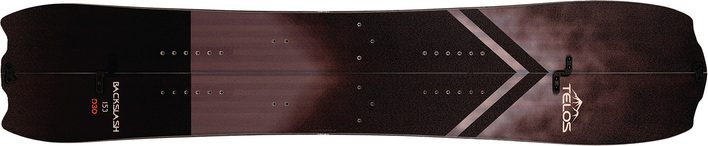
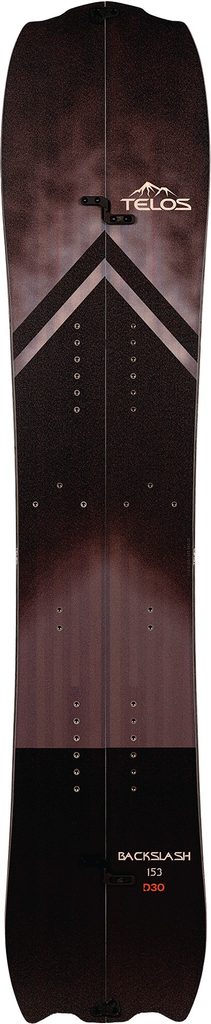
According to a Haines splitboarder who tested this board in a variety of conditions, the Backslash is a “laidback” layback aficionado that encourages windlip-chasing splitters to steer the volume-shifted shape from a relaxed, surfy, backseat stance. A multi-radius sidecut and a generously rockered nose deliver a “smooth, catch-free and comfortable” feel per a tester who made small turns in tight trees. Setback camber, subtle sidecut serration and a snappy flex from a poplar and paulownia core backboned by carbon stringers helped the Telos tackle a variety of conditions and terrain types. It was playful in freestyle-friendly terrain, with the short tail punching above its size when landing cliff drops. Per one tester, “It could still handle Mach 10 aprons off big Alaskan alpine terrain.” Speed-focused freeriders may want a more responsive shape, and vert crushers will have a hard time embracing the beefy Backslash.
TL;DR: A fun, floaty, surfy shape that’s fairly versatile, the Backslash is a blast on the descent, though not the lightest climber.
Where to buy
Telos Backslash Splitboard
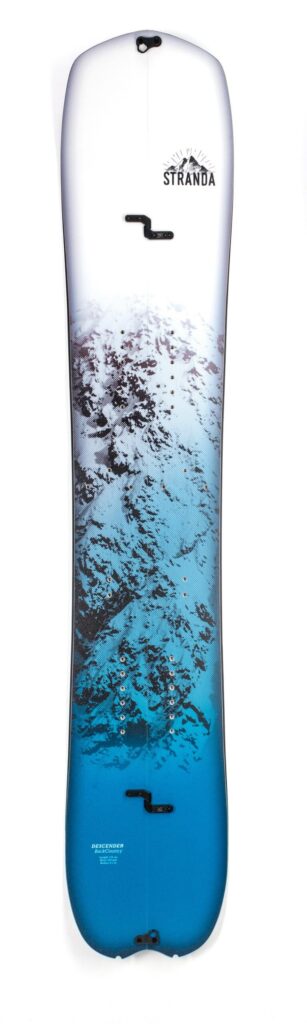
Stranda Descender Backcountry
Weight: 3,080g (158) | Lengths: 148, 152, 155, 158, 161, 162W, 166W | Price: $1,089 | strandasnowboards.com
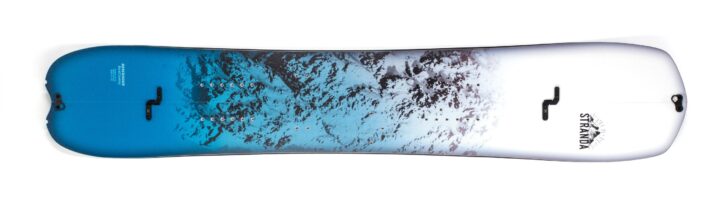
Stranda’s updated Descender split now features D3O inserts in the nose, a material commonly found in mountain bike and moto safety gear that stiffens upon impact. “Built to charge anything,” commented one Colorado tester who found the directional shape at its best when straight-lining. Much like the aerodynamic silhouette of an F1 racecar, the Descender’s outline suggests a penchant for pinning it. The freeride craft boasts a shallow sidecut, minimal taper, subtle bumps along inserts for extra grip on ice and 4 millimeters of camber. Under the hood is a triaxial glass job over a poplar and paulownia core reinforced with ash and carbon stringers. An “ultra-stiff tail” helps the Descender “hop turn through tight lines” and stomp landings, too, according to that Colorado rider. Testers found the Descender’s weaknesses in mellower terrain and chunder. “Plank is life,” offered one Utah rider, recommending the Descender solely to heavier splitters who won’t be dominated by steely flex.
TL;DR: A stout big-mountain beast that’s at its best straight-lining at speed.
Where to buy
Stranda Descender Backcountry
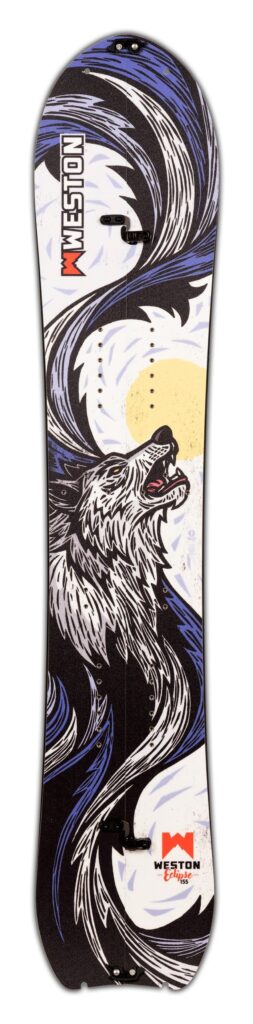
Weston Eclipse Splitboard
Weight: 3,080g (150) | Lengths: 145, 150, 155 | Price: $989 | westonbackcountry.com
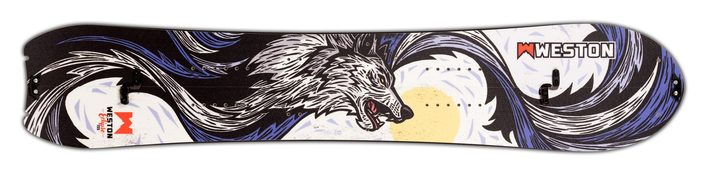
Originally launched as a women’s board, Weston’s Eclipse is now marketed as a unisex option for smaller riders. Our hardest-charging female tester said it’s “stiff and reliable” compared to most women’s boards but too forgiving when pushed. “I love the Eclipse for playful riding and feeling like an agile butterfly boppin’ around the mountain on a powder day,” she explained, calling it “fun for learners.” The Eclipse is a durably built, tapered, surfy deck with a broad, floaty nose, camber underfoot and vertically laminated carbon stringers. It features a cutaway moontail and a softer-flexing poplar and bamboo core than the Editors’ Choice Backwoods. A tester noted that the dexterous sidecut and waist and spry torsional flex encouraged “cheeky, nimble” small- to medium-radius turns. However, chunder overwhelmed the Eclipse, and although the forward-mounted toe piece inserts made kickturns effortless, our tester grumbled that they reduced float breaking trail.
TL;DR: A surfy, directional freeride deck offered in smaller sizes that’s fun and floaty, though hard chargers will crave more stiffness.
Where to buy
Weston Eclipse Splitboard
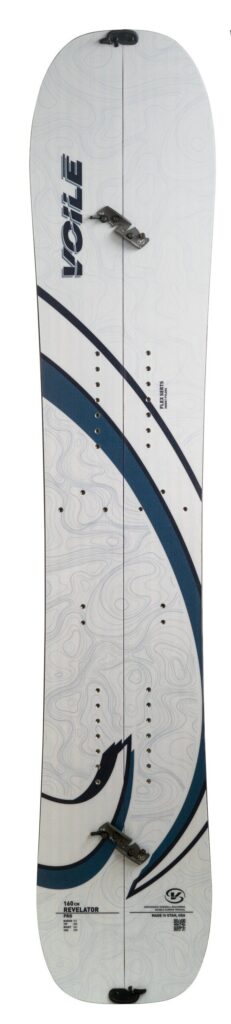
Voilé Revelator Pro
Weight: 2,960g (160) | Lengths: 147, 152, 157, 160, 163, 167 | Price: $950 | voile.com
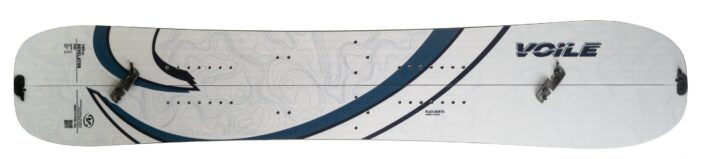
“Did this board go to obedience school?” questioned a rider born to disobey his elders. “Because it listens to every command immediately.” At 6’2” he was able to push through the mid-stiff flex and what he called the “best torsional rigidity on the market,” thanks to a carbon-wrapped paulownia core with triaxial fiberglass. The split is clamped by Voilé’s new Camlock Splitboard Hooks, which sit eight to nine degrees off axis to better crank the halves together. “Kept this board feeling like a solid,” said a Tahoe jibber. An early rise tip and wide shovel helped with kickturns. Underfoot camber and a wide, flat and minimally tapered tail provided easy, stable turning and a platform for lighter riders to stomp airs. This Pro model swaps a capped construction for continuous TPU sidewalls, meaning it ate chunder and variable conditions but lacked personality. “This wasn’t the most playful board,” explained one. “But I appreciated its predictability.”
TL;DR: A reliable, stable board that’s easy on the skintrack and, thanks to new split hooks, exceptionally solid on the down. It’s just not winning any awards from freestyle riders.
Where to buy
Voilé Revelator Pro
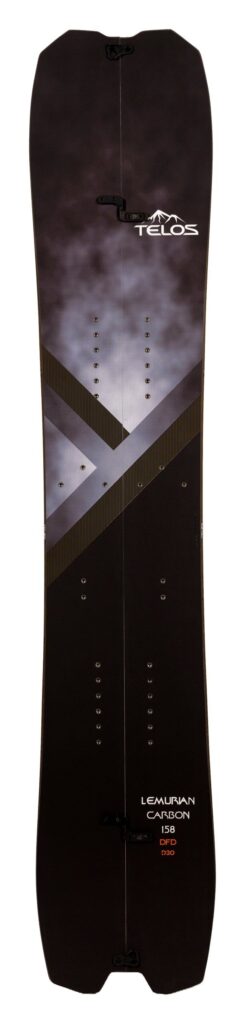
Telos Lemurian Splitboard
Weight: 2,898g (162) | Lengths: 158, 162, 166 | Price: $1,300 | telossnowboards.com
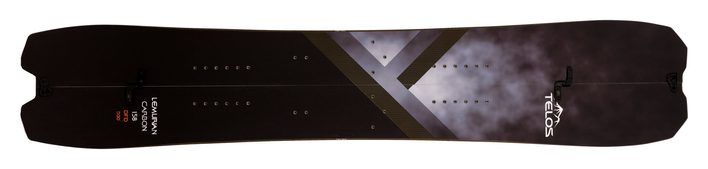
Under the topsheet of this lightweight, hyper-cambered board, there’s more tech than a Silicon Valley data center. A poplar and paulownia core is reinforced with bamboo insert blocks and vertical aluminum, carbon and D3O stringers, the latter of which stiffens upon impact to increase stability at speed. “Stiff and responsive, without a ton of playfulness,” said a Haines splitter. The deck features nose and tail rocker sandwiching heavy camber from just outside the inserts and a subtle, elevated reverse camber pocket between the feet. Combined with a generous sidecut, the Lemurian excels at larger arcing turns. However, a lack of taper and aggressive camber created a “grabby” feel in powder, per our tester. The lightweight build, camber and long effective edge made the Lemurian one of our favorite touring boards, but the nose and tail shape didn’t sync well with the brand-provided skins, leading to some delamination.
TL;DR: The Lemurian is an ultralightweight, cambered, confident vert-crusher that makes some sacrifices on the descent.
Where to buy
Telos Lemurian Splitboard
Burton Hometown Hero
Weight: N/A | Lengths: 146, 150, 154, 158, 158W, 162, 162W, 168 | Price: $1,000 | burton.com
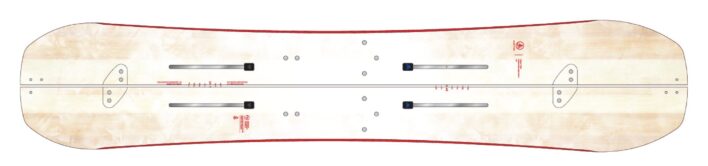
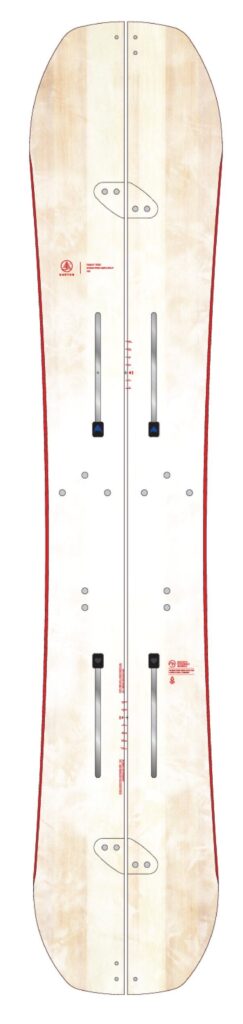
This freeride-forward deck boasts a rockered nose, 12 millimeters of taper and serious setback for float, while rear-heavy camber and a capable big-mountain-ready sidecut deliver reliability. “I’d consider it a daily driver,” commented an avalanche instructor who particularly enjoyed the nose rocker’s smooth turn initiation. “It supports fall-line, directional riding with an emphasis on the entries and exits of the turns.” A Coloradan chimed in, “If you mix a power lifter with a samurai, you get the Hometown Hero: explosive, strong and precise.” Both riders judged edge hold solid and transition speed impressive, particularly given the width of the tested 162W. They agreed that splitters looking to take pooches on low-angle laps could find more forgiving shapes. The Hometown Hero gains torsional stiffness from its 45-degree carbon laminates that suit aggressive veterans. While this build helps the Burton stomp, it requires speed and rider input to pop well.
TL;DR: This split carves, floats and stomps like a big-mountain boss, but stiffness makes the Hometown Hero better suited for local legends than timid intermediates or casual splitters.
Where to buy
Burton Hometown Hero
K2 Snowboards Marauder
Weight: N/A | Lengths: 147, 151, 156, 158W, 159, 162, 163W, 166W | Price: $1,160 | k2snow.com
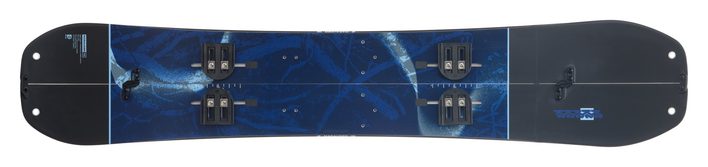
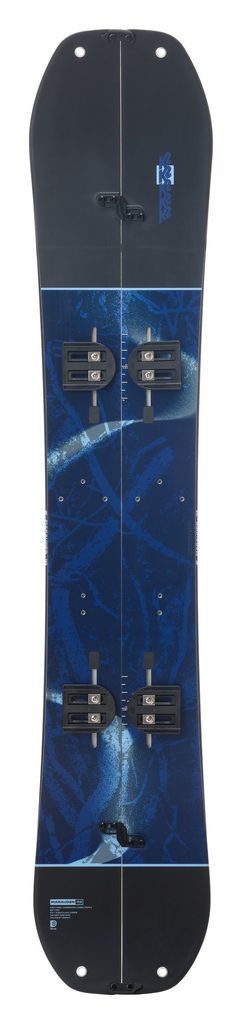
The Marauder’s bamboo, aspen and paulownia core is laminated with biaxial fiberglass that’s woven with carbon fiber stringers. The result is a mid-flexing ride multiple testers scored as “responsive,” with a malleable waist that allows for quick wiggles. “Waist flex made turn initiation breezy,” commented an aggressive Eastern Sierra splitter. A Colorado rider agreed that the K2’s mid-range sidecut turned “on a dime,” but found that edge-to-edge quickness required him to stay on his toes at lower speeds. Said Sierra tester found the upper limits of the shape when straight-lining and voiced that fellow fall-line-oriented freeriders would crave more reliability pinning through tech terrain. The Marauder’s a quiver killer that performs best in the middle ground. Still, that Sierra rider loved the poppiness of the camber-dominant profile, as well as minimal setback and taper that imbues the K2 with switch and freestyle skills. “One of my favorite jump boards of the test,” he reported.
TL;DR: A relatively affordable package deal that comes with skins and pucks, the Marauder is a fast-turning split that loves to boost.
Where to buy



Related posts: