

On Tuesday, Feb. 24, professional splitboarder Stratton Matteson was caught and killed in an avalanche near Joffre Peak outside of Pemberton, B.C. Matteson was a pillar in the splitboard community, known not only for his daring descents but for his dedication to environmentalism. In his memory, we are republishing Tom Hallberg’s profile of Matteson published in Issue 162, The Outliers Issue.
Ignoring the Temptations of Convenience
Stratton Matteson spent more days deep in the Cascades than any other splitboarder, but when he considered the impact of driving a gas-guzzling car into the mountains, he simply said no. For five years, he quietly pioneered a more environmentally sustainable path, biking every time he went out. It was a way for him to live his ideals, provide an example for those with similar ethics and expend his boundless energy.

Legend has it that before dawn on winter mornings in Central Oregon, a lone cyclist pedals the dark roads toward the mountains. In the interstitial silence between the scrape of snowplows on the Cascade Lakes Highway and the murmur of traffic headed to Mount Bachelor, you’ll catch the haunting echo of a squeaky crank, the tik-tik-tik of a chain feeding over cassette teeth.
Ice hangs in his beard. Frosty exhalations trail behind him, ghostly tendrils dissipating into night. By the time anyone else is up, he’s gone, the bike left at a trailhead and a skintrack fading into the forest the only clues of his existence. Word is he’s riding the steep, alpine lines you dream about.
Oregon is a place of myths. Its indigenous tribes believe Coyote has played tricks on them since time immemorial. In modern times, weed-addled hippies and paramilitary wannabes alike chase Sasquatch through thick forests, sustained by whispers and shadows. Conspiracy-minded Northwesterners believe D.B. Cooper, who in 1971 hijacked a plane out of Portland, stole $200,000, parachuted into the woods and was never found, survived, despite the prevailing evidence that he died in the jump.
In short, Oregonians are predisposed to believe the unbelievable, but this yarn of the cyclist who leaves before everyone gets up, splitboards all day and comes home after everyone is tired is true.
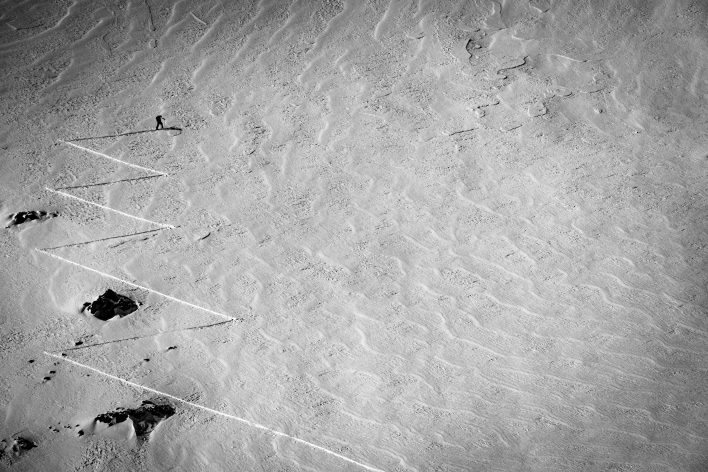
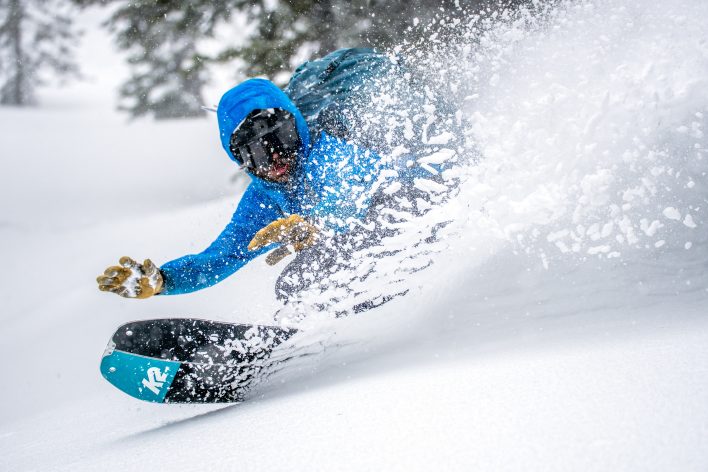
Though his beard and tendency to traipse through the woods during twilight could inspire Bigfoot rumors, Stratton Matteson isn’t a mythological creature, just an anomaly. At 27, he’s done a lifetime of long tours and big objectives from the saddle of his Surly Ogre.
Starting from his home in Bend, he rides about 120 backcountry days a year. A typical bike-to-board day might include 40 to 60 miles round trip of pedaling, along with climbing and riding a couple of high-alpine laps, which in the Cascades are often 3,000 feet apiece. He snow camps more than most, maximizing the pedaling by linking big days. “The style and the fashion in which I have to do it make me more committed,” he says.
Eight-thousand feet in a day might feel casual to Matteson. He’d never tell you that, but his friends will. “He’s just got these tree trunks of legs because he bikes everywhere,” says fellow Cardiff Snowcraft-sponsored rider Neil Provo. “He’s a beast, an absolute beast.”
Midwinter, the Oregon Cascades are a difficult labyrinth to crack. Approaches can be 10 miles or more round-trip (after reaching the trailhead), and wind and snow hammer the alpine zones on Matteson’s nearby peaks like the Three Sisters, Broken Top, Three Fingered Jack and mounts Jefferson and Washington. Dozens of lines drape each one—myriad fins, couloirs and headwalls—and, unlike the masses who wait until spring, Matteson is out there, often alone, picking them off throughout the winter. “No one else is doing that,” says Jason Hummel, a photographer and first ascensionist with one of the most impressive Pacific Northwest resumes.
This past October and November, before most people scrape their storage wax off, Matteson ticked off impressive alpine excursions like South Sister’s now-dead Clark Glacier and a double-dip day on South Sister and Broken Top. With hundreds of big descents across the state, Matteson is a professional splitboarder in the vein of Nick Russell, one who’s built a name solely on backcountry pursuits. “He’s the guy in Oregon, right?” Hummel says. “I think about things that I’ve done in the Cascades, and I spent a whole lifetime. He’s done more in a couple of years than I’ll probably do in my whole life.”
It’s clear Matteson’s motivation isn’t to garner acclaim or talk up that objectively impressive list. “The thing that keeps me coming back is the opportunity to explore and ride wherever you want and see something that’s inspiring to ride, and then figure out how to go about doing it,” he says. His friends agree. “It’s not about being a name or putting out a movie,” riding partner Matt Colton says. “He really wants to get a nice ride. He really wants to tire himself out.”
Colton, Hummel and others focus on Matteson’s indefatigable enthusiasm for hiking and riding, and his intensity and humor on the skintrack. But being the top rider in Oregon is just one part of his story—the other is his steadfast environmental philosophy and commitment to calling attention to fossil fuel use in the ski industry. For Matteson, the need to snowboard exists alongside a desire to forge a relationship with the mountains based on reciprocity, not exploitation or consumption, and to be an example for others to challenge their own practices.
That ethos came, in part, from an unlikely place—New York City.
In 2016, Robin Greenfield had a crazy idea. He lives a zero-waste lifestyle, but for one month, he would consume like the average American, buying packaged foods and dining out several times a week. “The catch is,” he says, “I’m going to wear every single piece of trash that I create in order to create a visual that shows just how much trash one person makes.” By the end, he was wearing 84 pounds of trash in a clear plastic suit, walking around the Big Apple as part of his Trash Me campaign to demonstrate the extent of our consumptive lifestyles.
A well-known environmental activist, Greenfield works on issues of overconsumption, waste and cleaner living. “The power is the people who see them,” he says of his campaigns, which he promotes on social media and in the traditional press. “They see the truth. When we don’t know the truth behind our actions, we’re not going to change them.” One person who noticed Trash Me was a young Stratton Matteson, already charting his way as an up-and-coming splitboarder. It planted the seeds of a radical transformation.
If it strikes you as odd that a snowboarder in his early 20s was making life choices based on environmental activism, Matteson’s upbringing will be instructive. Born in Eugene, Oregon, he moved with his parents to Vermont when he was 7, then to Bend in high school. In those intervening years, his family traveled as his parents, George Wuerthner and Malia Matteson, worked for environmental nonprofits and wrote a plethora of guidebooks and ecology texts. “Both of them played a big role and had a big influence in shaping my values and my outlook on the world,” he says, “And that started at a young age.”
After sustaining a knee injury riding the Mount Bachelor terrain in his late teens, three subsequent surgeries and a year and a half of rehab, the young rider gravitated toward splitboarding. He’d been drifting that direction, and post-recovery he wanted full days in the mountains that would be less harsh on his body. There was, however, a problem.
“It’s a really resource-intensive sport, and the resource intensity has been glorified almost in the ski world,” Matteson says. “The top thing is to get in a helicopter and get dropped off, or fly around the world and then get in a helicopter and get dropped off. Or that’s what you’ll see in a lot of films.” He’s not wrong. Data on the carbon footprint of skiing is scant, but in 2024 French resort Tignes estimated a resort skier’s daily carbon emissions to be 108 pounds, with 52% coming from transportation. Just a few percentage points come from resort operations, the rest from gear production and food, meaning backcountry skiing has similar emissions levels as a resort day.
Heli, a heli-skiing blog and travel site, estimates taking a bird leads to 374 pounds of emissions per skier, per day. Some companies have committed to carbon-offset programs to reach neutral emissions, but those are unregulated and often rife with problems. A single domestic flight leg creates 500 to 1,000 pounds of carbon emissions per passenger. For comparison, the average American produces between 50 and 100 pounds per day.
Looking at that landscape, Matteson opted out. “At a certain point, I said, ‘Well, yeah, I don’t like that,’” he says. “I’m directly contributing to this issue, all in the name of snow and snowboarding and backcountry riding. And it is a pretty selfish pursuit.”
One option would have been to stop snowboarding. Another was, as he puts in his Instagram hashtags, to go “off fossil.” Inspired by Greenfield’s radical activism and the proliferation of bike-to-ski movies, in which athletes use two wheels for a long trip or single objective, Matteson set a goal of going one year on the bike. One year of early mornings and late nights. One year of meeting partners who commuted in warm cars at trailheads. One year of cold fingers and a frozen beard.
One year came, then went. Then, two, then three. Four. Five. “There wasn’t a reason for me to go back, especially with how I felt it was all based around ethics and morals,” he says. “Once I realized that, there wasn’t really a thought of going back.”
Things stayed that way until this fall.

Part of being a professional snowboarder is going on brand trips. Companies sponsor athletes to be ambassadors, to sell skis and boards and apparel, to be in front of the camera. That requires travel, but when Matteson is invited on Cardiff Snowcraft trips to Salt Lake City, he doesn’t abandon his ethos. He also doesn’t pedal the 650 miles.
“These team trips where he’d come out, he’d ride the train from Oregon out to Utah,” teammate Provo says. “That was pretty cool to see another aspect of his dedication to the environment.”
As a journalist and observer of the bike-to-ski fad, namely the attention it’s received in films and brand marketing, I’ve been skeptical. Athletes use their films to talk about biking’s environmental benefits. Then through subsequent trips or social media, it’s clear they return to driving, flying, snowmobiling and heli skiing to sustain their profession. Call it greenwashing, call it an unwillingness to change for the greater good, call it the reality of living in a fossil-fuel-powered world, the results are bluster and big words without meaningful change.
For Matteson, it’s a lifestyle, not a one-off. His commitment to removing himself from a broken system is comprehensive. When he’s not splitboarding, he runs almost every aspect of his native plant landscaping business, Tangled Roots Restoration, with an e-bike and trailer. Even the concept of returning high-desert flora to Bend’s yards fits with the praxis of environmental consciousness.
It’s limiting, no doubt. Demarcating oneself in a radius defined by a train and bike cuts off many of the world’s finest ranges. “Me and him will kind of get at it because I like to travel, and I really have wanted to get him on a trip,” Colton says.
So far, Matteson has valued his position as an environmental example above all else. If most bike-to-ski forays have been transient, Matteson took a page out of Greenfield’s book and went to one extreme to shake up the status quo. “It’s not like I expect everyone to go out and just start riding the bike everywhere, or go completely cold turkey,” he says. “The intention is to get minds thinking and starting to analyze things more and being intentional about our actions.”
As Greenfield puts it, “We need extreme people because, it’s just a simple fact, if nobody takes it to the extreme, then we never see that we can go to a further possibility.”
Embodying that extreme, however, has been tiring. After five years, Matteson started noticing the limitations. Spending 14 hours a day to go touring meant he wasn’t seeing his partner, Maddie, as much. It was hard to see friends, except on the skintrack. Speeding back to Bend at night, sweaty from touring, his face and fingers felt that much colder.
So, he made a fundamental reevaluation and in fall 2024 bought an electric vehicle, an all-wheel-drive Chevy Equinox. He’s already driven it to Washington to test himself in the North Cascades. If that feels like selling out to you, I’d challenge you to imagine having lived that way for five years, the amount of missed time with loved ones, the late nights spent repacking and planning.
Matteson has been one of the extremes that Greenfield says push the middle. Maybe, as Matteson makes his life more sustainable, it’s time for us to pick up the mantle. And it’s not like he’ll never return to the saddle. “I love biking, and I’ll definitely be doing plenty of biking exploration and trips,” he says. “But I also really love snowboarding and splitboarding, and getting this EV is kind of a compromise.”

North Sister is the craggiest and least skied of the Central Oregon triad. Matteson and friend Sadie Ford, another bike-to-board enthusiast, hiked toward camp at the mountain’s base in “this sleet, rain, squall bullshit,” Ford says. Most would have turned around, but they persisted, banking on a turn in the weather.
The Cascades have a habit of turning awful, rainy conditions into creamy pow for the optimistic. On this February 2024 trip, Ford says, “We got into camp that night, and it just all blew off and opened up.” On their second day, they headed for the North’s Thayer Headwall. East facing, fluted, overhung by rotten rock and with a tight, well-defined choke, it’s rarely in condition and safe. According to Matteson’s research, few men have skied it midwinter and, until then, no women.
“The whole time on the way up, he’s just gassing me up,” Ford says. “He’s like, ‘You know, you’re gonna be the first woman to do this line in winter.’” Turns out, he was right. The pair joined the elite club of those who have decoded Thayer’s complex equation of a long approach, brutal weather, damp camping and overhead hazards.
Beyond the environmental principles and long days in the saddle, big objectives are Matteson’s niche in the Northwest, what makes him a riddle wrapped in an enigma wrapped in Gore-Tex. “Here’s a guy going out skiing all the hard peaks, oftentimes by himself,” Hummel says. “He’s out there in the middle of winter, and he’ll spend a week out there. It’s brutal, it’s excruciating, and he’s just ready to go.”
No matter his mode of transportation, he’s still going to be ready to go. We’ll certainly hear the tik-tik-tik of a bike chain less, but his friends are proud of his yearslong commitment and excited to see more of him. He’s quietly led the charge to bring awareness to the industry’s environmental impact, and now the ball is in our court. Behind the wheel of his electric Chevy, he’s staying true to that goal by setting a new example that’s more attainable for the average person.
As Ford says, “He’s got his vector pointed on what is important to him and doesn’t get caught up in the snares of life and the temptations of convenience.
“This is what is good for his life and his heart. And he’s still doing it in a way that aligns with his ideals.”
Our hearts go out to Matteson’s family and friends as well as the greater backcountry community. These past couple of weeks have been heavy with loss. If you’re looking for support, most local avalanche centers offer resources for grief, trauma and loss in the mountains.
Related posts: